

VISHNU: GUARDIAN OF THE COSMOS, AVATARS, AND ULTIMATE BALANCE
Imagine a hypnotically beautiful being with deep midnight-blue skin like the sky just before the first star appears, resting peacefully on the coils of a thousand-headed cosmic serpent. Around him? An infinite ocean of primordial milk. He slumbers, but his sleep is no mere pause: it is the very rhythm keeping reality alive. Every time he inhales, entire universes are created; every time he exhales, they dissolve.
Welcome to the world of Vishnu, the most fascinating, heroic, and complex deity in the Hindu pantheon.
If Western mythologies have accustomed us to hot-tempered, vengeful gods obsessed with their own power, Vishnu belongs to a completely different class. He is the Preserver. In the great Hindu trinity (the Trimurti), while Brahma draws up the blueprints of the universe and Shiva plays the role of the ultimate transformer to allow renewal, Vishnu has the hardest job of all: keeping the machine running, maintaining peace, and repairing the fabric of reality whenever everything goes haywire.
To save the world, Vishnu doesn't just hurl thunderbolts from a distant throne. He descends to Earth. He incarnates. He becomes a giant fish, a roaring lion, an accomplished prince, or a charming flutist.
Fasten your seatbelt: we are setting off on a journey through ages, dimensions, and epic legends of the ten-faced god.
I. THE TOUGHEST JOB IN THE COSMOS: WHAT IS THE PRESERVER?
To understand Vishnu, one must first grasp the concept of Dharma. Dharma is not just a moral rule or a religion; it is the natural order of the universe, the gravity holding the stars together, the justice binding all living beings, the cosmic harmony without which everything collapses into ultimate chaos (Adharma).
The Hindu universe is cyclical. It is born, grows, questions itself, degrades, collapses, and is reborn anew. In this great cosmological carousel divided into four vast ages (Yugas), corruption gradually creeps in. Demons (Asuras) gain the upper hand, kings turn into tyrants, and truth fades away. That's when Vishnu's hotline rings.
His mission? To restore Dharma. Not too much, not too little. Vishnu is not a god of total eradication. He is the deity of the golden mean, strategy, grace, and preservation.
The Appearance of a Cosmic Sovereign
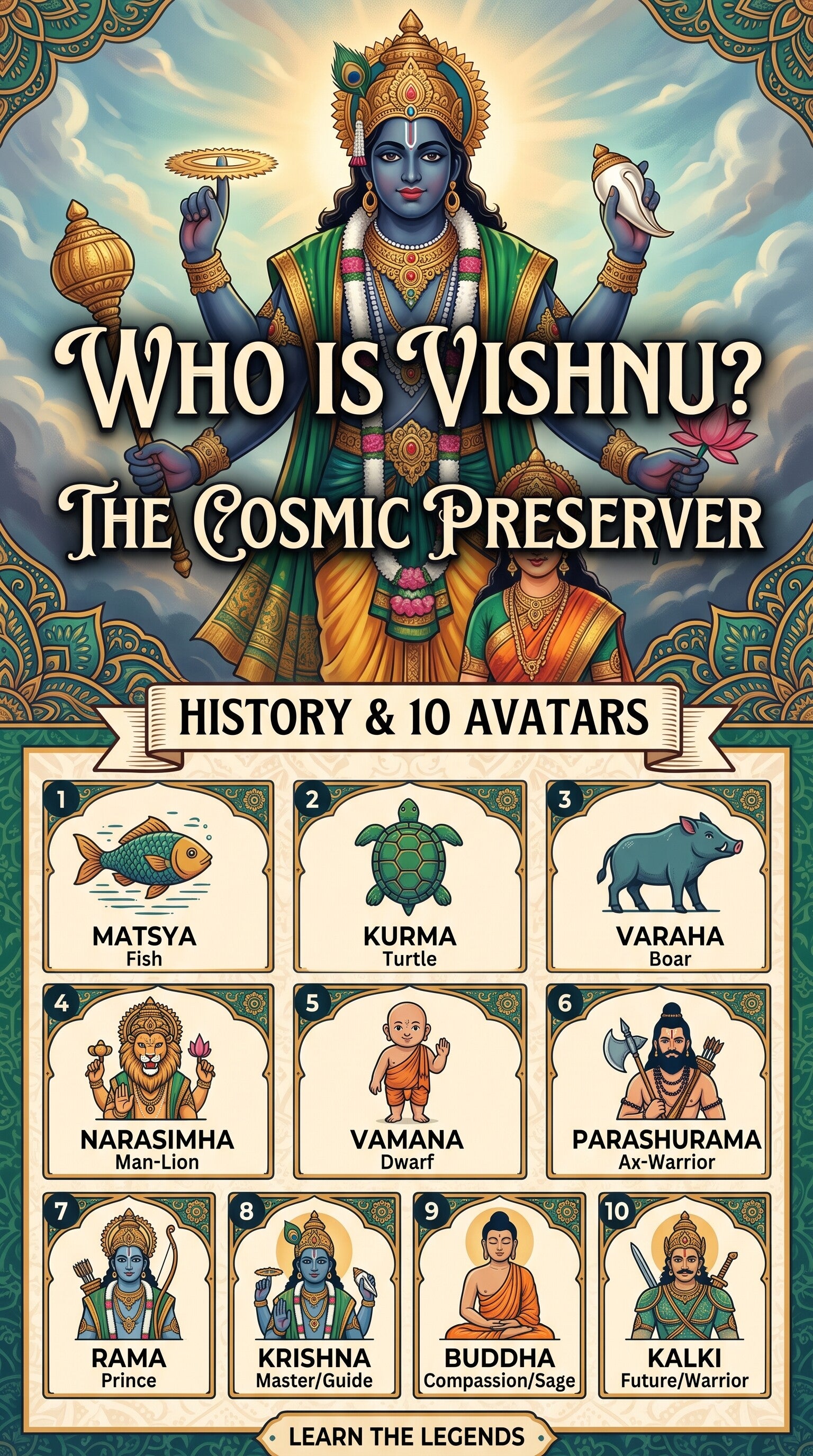
When he isn't navigating Earth in human form, Vishnu manifests in his celestial four-armed form (Chaturbhuja). Every detail of his posture and attire is a living metaphor:
-
The Blue or Dark Skin: It evokes the immensity of infinite space and the depths of unknowable oceans.
-
The Conch (Panchajanya): A sacred conch shell. When he blows into it, the sound emits the primordial Om, striking fear into demons and awakening the consciousness of created beings.
-
The Luminous Disc (Sudarshana Chakra): A razor-sharp weapon forged from pure solar light, spinning on his index finger. It slices through illusions, severs the ego, and vanquishes evil in the blink of an eye.
-
The Mace (Kaumodaki): A massive golden mace representing physical strength, absolute authority, and the power of divine law.
-
The Lotus Flower (Padma): A magnificent flower that grows out of the mud without ever becoming stained. It symbolizes purity, beauty, and spiritual liberation amidst the illusions of the material world.
On his chest shines the Kaustubha jewel, containing the light of all souls in the universe, along with a curl of golden hair called Srivatsa, the mark of divine love.
II. VISHNU'S ECOSYSTEM: A GIANT SERPENT, A FIREBIRD, AND THE GODDESS OF FORTUNE
A god of this stature doesn't travel alone. Around Vishnu revolves a phenomenal supporting cast.
Ananta Shesha: The Cosmic Sofa
Before time, before light, lies the Primordial Ocean of Milk (Kshira Sagara). Floating upon this ocean is Shesha (also known as Ananta, meaning "The Infinite"). He is a colossal serpent with a thousand heads that occasionally breathe fire or venom, yet he bows in total devotion before Vishnu.
Shesha's thousand heads form a protective canopy over the sleeping deity. It is said that the weight of all the planets in the universe rests on one of Shesha's heads. When the serpent yawns, the Earth quakes. And when the end of a cosmic cycle arrives, it is Shesha's venom that burns the universe to prepare for Shiva's grand reset.
Lakshmi: The Energy of Abundance
By Vishnu's side stands Lakshmi, the goddess of beauty, wealth, prosperity, and good fortune. But take note: in Hindu thought, wealth isn't just money; it encompasses health, joy, generosity, and spiritual illumination.
Vishnu and Lakshmi are inseparable. He is matter; she is movement. He is the word; she is the meaning. Whenever Vishnu incarnates on Earth in human form, Lakshmi descends alongside him under another identity to remain by his side (Sita for Rama, Radha and Rukmini for Krishna).
Garuda: The Solar Mount
When Vishnu needs to travel across the multiverse in an emergency, he doesn't ride a magic cloud: he mounts Garuda, the king of birds. Garuda is a giant hybrid with a human body and the head, wings, and talons of an eagle. His wings are so powerful that a single flap can stop the rotation of planets or blow mountains away. Sworn enemy of malevolent serpents, he embodies pure speed, courage, and unfaltering devotion.
III. THE DASHAVATARA: VISHNU'S TEN EXTRAORDINARY INCARNATIONS
This is where the story turns into a full-blown action-adventure epic. The term Avatar comes from the Sanskrit Avatara, which literally means "Descent." An avatar is a physical incarnation of the divine on Earth.
Tradition highlights ten major incarnations, known as the Dashavatara. Intriguingly, the sequence of these ten avatars closely mirrors modern evolutionary theory: starting in the water, moving to amphibians, then land mammals, half-humans, early humans, civilized men, politicians, philosophers, and finally a future savior.
Settle in and enjoy the epic tale of the ten avatars.
1. Matsya: The Giant Fish of the Deluge
At the very beginning of time, the world was threatened by a devastating cosmic deluge orchestrated by a demon named Hayagriva, who had stolen the Vedas (the sacred scriptures containing the knowledge of creation).
On Earth, a devout king named Manu was performing his daily ablutions in a river when a tiny fish slipped into his cupped hands. The fish whispered: "Save me from the big fish that want to eat me, and I will save you from the impending disaster."
Filled with compassion, the king placed the tiny fish in a jar. By the next day, the fish had grown too big for the jar. The king transferred it to a well. The following day, the fish was as big as the well! The king moved it to a lake, then to the Ganges River, and finally to the ocean. Within days, the fish had grown into a colossal creature with scales gleaming like gold and a monumental horn on its head.
The fish revealed itself to be Vishnu: Matsya. He warned Manu: "In seven days, the oceans will overflow and submerge the world. Build a giant ship. Take with you the seeds of all plants, a pair of every animal species, and the seven great sages."
When the apocalyptic storm erupted, Matsya reappeared amidst the monstrous waves. Manu tied the ship to the giant fish's horn using the serpent Vasuki as a rope. Matsya towed the ark through the raging waters at the end of the world to the peak of the Himalayas, preserving life and knowledge for the next cycle.
2. Kurma: The Turtle and the Great Churning of the Ocean
This is arguably one of the wildest and most poetic stories in world mythology.
One day, due to a curse pronounced by an angry sage, the gods (Devas) lost their vigor, glory, and immortality. Sensing the opportunity, the demons (Asuras) seized control of the universe. Desperate, the gods pleaded with Vishnu.
Vishnu devised a brilliant yet risky strategy: a temporary alliance with the demons. "Propose to the demons that you churn the Ocean of Milk together. From this ocean will emerge Amrita, the nectar of immortality. You will share the spoils."
To churn an entire ocean, giant tools were required:
-
Mount Mandara served as the churning rod.
-
The giant serpent Vasuki wrapped himself around the mountain to act as the rope. The demons pulled from one side (the head), and the gods from the other (the tail).
However, as the cosmic churning began, a catastrophic problem arose: Mount Mandara, far too heavy, started sinking into the soft floor of the milk ocean! The entire operation came to a halt.
That's when Vishnu stepped in as Kurma, a giant turtle whose shell was harder than diamond. He slid beneath the sea and placed the mountain directly onto his back. With Kurma's shell as an indestructible pivot, the churning resumed at full power.
From the churning ocean emerged wonders: Goddess Lakshmi, the white elephant Airavata, a winged horse, divine jewels... and finally, the cup of Amrita. Through a masterstroke of cleverness (where Vishnu transformed into a woman of enchanting beauty, Mohini, to distract the demons), the gods reclaimed the nectar and their immortality.
3. Varaha: The Cosmic Boar
The demon Hiranyaksha had committed the unthinkable: in a fit of boundless arrogance, he tore Earth (personified as the goddess Bhudevi) from her orbit and plunged her into the dark, toxic depths of the cosmic ocean. The planet was suffocating in the dark.
From the nostril of the creator god Brahma, a tiny spark emerged, taking the shape of a miniature boar. Within seconds, the creature expanded to the size of a mountain. This was Varaha, Vishnu's boar avatar.
With eyes like lightning flashes and a roar that shook the heavens, Varaha dived headfirst into the cosmic ocean. Tracking Earth by her scent, he located Goddess Bhudevi at the bottom of the abyss and gently lifted her upon his massive ivory tusks.
But Hiranyaksha lay in wait. A titanic underwater battle broke out. The blows from their maces generated shockwaves that threatened to shatter time itself. After a fierce battle lasting a thousand years, Varaha vanquished the demon with a decisive blow, rose to the surface, and restored Earth to her orbit, saving humanity from total extinction.
4. Narasimha: The Man-Lion and the Defeat of Logic
This is Vishnu's most intense, dramatic, and philosophically profound incarnation.
Following the death of his brother Hiranyaksha, the demon king Hiranyakashipu swore eternal hatred against Vishnu. To render himself invincible, he performed severe austerities for centuries. Impressed, Brahma granted him a boon.
Hiranyakashipu, clever as he was, demanded seemingly airtight safety conditions: "Grant that I may not be killed:
-
Neither by a man nor by an animal.
-
Neither indoors nor outdoors.
-
Neither by day nor by night.
-
Neither on the ground nor in the air.
-
Neither by a man-made weapon nor by a divine weapon.
-
Neither on Earth nor in the sky."
Confident in his invulnerability, the demon declared: "I am God!" He outlawed the worship of Vishnu under penalty of death.
Yet destiny has a sense of irony: the demon's own son, young Prince Prahlada, became Vishnu's most devoted follower. Enraged, Hiranyakashipu tried to execute his son by every imaginable means: throwing him off cliffs, trampling him with elephants, exposing him to venomous snakes, poisoning him... Every time, Prahlada's pure faith in Vishnu saved him.
Driven to madness, the demon king grabbed Prahlada, pointed at a stone pillar in his palace, and bellowed: "You say your Vishnu is everywhere? Is he inside this stone pillar?" Prahlada softly replied: "Yes, he is."
Hiranyakashipu smashed the pillar with his iron mace. The stone exploded with a deafening crash. Out from the shattered rock sprang Narasimha: a terrifying figure with an athletic human body and the roaring head of a lion with fiery eyes.
Observe how Vishnu bypassed the demon's boon with surgical precision:
-
Narasimha was neither man nor animal, but a perfect hybrid.
-
He grabbed the demon and dragged him to the threshold of the palace door (neither indoors nor outdoors).
-
It was the hour of twilight (neither day nor night).
-
He laid the demon across his lap (neither on the ground nor in the air).
-
He used no weapons, but tore through the demon using his natural claws.
The tyrant was undone. Narasimha's fury was so fierce that even the other gods dared not approach. Only young Prahlada, stepping forward fearlessly with pure love, managed to soothe the divine lion, who gently licked his face like a kitten.
5. Vamana: The Dwarf Who Measured the Cosmos
After monsters and violence, Vishnu shifts gears entirely. Here, there are no claws or bloody battles: just intellect, diplomacy, and a monumental lesson in humility.
A noble and generous demon king named Mahabali (or Bali) had conquered the three worlds (Earth, Heavens, Underworld) through righteousness and valor. Though an Asura, Bali was just, but his immense power threw the cosmic balance off track. The gods were once again homeless.
Vishnu assumed the form of Vamana, a young dwarf Brahmin carrying a bamboo umbrella and a water pot. He attended a grand sacrificial ceremony where King Bali was distributing gifts to anyone who asked.
Charmed by the piety and radiance of the young dwarf, Bali said: "Ask of me whatever you desire: gold, land, palaces, wealth, or kingdoms!"
Vamana smiled humbly and replied: "O great King, I need none of those things. Simply grant me as much land as I can measure in three steps."
The king's guru, the sage Shukracharya, sensed the trap and whispered: "Refuse! It is Vishnu in disguise!" But Bali, too honorable to break a promise of hospitality, declared: "Even if he is the Lord of the universe himself, I will not back out of my word."
Then, before the astonished eyes of the court, the dwarf began to grow. He expanded beyond the clouds, the mountains, and the stars. This was the form of Trivikrama (He of the three great strides):
-
With his first step, he covered the entire Earth.
-
With his second step, he covered the Heavens and all celestial realms.
He paused and asked with a voice echoing across space: "O King Bali, I have covered all of creation. Where shall I place my third step?"
Bali, realizing the divine majesty of his visitor and overcoming his ego, bowed deeply and said: "Lord, place your third step upon my head."
Vishnu placed his foot on Bali's head, gently pressing him down into the underworld (Patala). Touched by the king's devotion and nobility, Vishnu granted him eternal ruler ship over the underworld and permitted him to return once a year to visit his people (a festival celebrated to this day in Kerala as Onam).
6. Parashurama: The Ax-Wielding Warrior
As centuries passed, the warrior and ruling class (Kshatriyas) grew corrupt, tyrannical, and oppressive toward commoners and sages alike. The societal balance was broken.
Vishnu incarnated as Parashurama ("Rama with the Ax"), a Brahmin endowed with phenomenal physical strength and armed with a divine ax gifted by Shiva himself.
When arrogant kings killed his father and stole the sacred cow Kamadhenu, Parashurama went on a holy crusade. He traversed the entire Earth and cleansed the world of corrupt rulers not just once, but 21 times in succession!
Parashurama embodies unyielding justice against the abuse of political power. He is one of the few Chiranjeevis (immortals of Hindu tradition). According to legend, he still lives in deep meditation atop remote mountains, awaiting the arrival of the final avatar.
7. Rama: The Ideal Prince and the Quest of the Ramayana
Here we enter one of the greatest literary and spiritual epics in human history: the Ramayana.
Vishnu incarnates as Rama, crown prince of the kingdom of Ayodhya. Rama is the personification of virtue, duty, truth, and compassion—the Maryada Purushottama, the ideal human being.
Yet Rama's life is a series of profound trials:
-
On the eve of his coronation, due to the scheming of a jealous stepmother, he is banished to the wild forest for 14 years.
-
Without a word of complaint, out of respect for his father's honor, he goes into exile accompanied by his beloved wife Sita (an incarnation of Lakshmi) and his devoted brother Lakshmana.
-
Deep in the forest, the ten-headed demon king Ravana, ruler of Lanka, abducts Sita through trickery and carries her off to his unreachable citadel.
Thus begins a heroic quest. Rama does not summon heavenly armies. Instead, he allies with the forest people, the Vanaras (a tribe of monkey-like beings), among whom stands Hanuman, the monkey god whose limitless strength stems from his pure devotion to Rama.
Together, they accomplish the impossible: building a floating stone bridge across the ocean to link India with Lanka (Rama's Bridge). A fierce war ensues. Rama confronts Ravana in a legendary duel and slays the ten-headed tyrant with a blessed solar arrow.
Yet the Ramayana is more than a tale of victory. It is a moving exploration of personal sacrifice, loyalty, love, and the cost of choosing duty (Dharma) above personal happiness.
8. Krishna: Master of the Divine Play
Where Rama represents rule and strict duty, Krishna embodies freedom, joy, diplomacy, passion, and the art of living. Krishna is not merely viewed as a fragment of Vishnu: for millions of devotees, he is the supreme personality of godhead (Svayam Bhagavan).
Krishna's life unfolds like a three-act adventure:
Act 1: The Butter Thief and the Wonder Child
Born in a dungeon to escape his tyrannical uncle Kamsa, infant Krishna is smuggled across the river to the pastoral village of Vrindavan. There he grows up among cowherds and milkmaids (Gopis). A beloved yet mischievous child, he steals butter hung from ceilings, defeats demons sent to assassinate him as if it were child's play, and enchants everyone by playing his flute under the moonlight. His bond with Radha remains the ultimate symbol of mystical love between the human soul and the Divine.
Act 2: The King and Strategist
Upon reaching adulthood, Krishna vanquishes the tyrant Kamsa, frees his parents, and builds the golden city of Dwarka on the ocean coast. He becomes a revered diplomat and master strategist who uses wit, humor, and intelligence to protect the righteous.
Act 3: Guide of the Bhagavad-Gita
When the colossal war of the Mahabharata breaks out between two factions of the same family (the Pandavas and the Kauravas), Krishna vows not to wield weapons. Instead, he serves as the charioteer for his friend, Prince Arjuna.
On the brink of battle, Arjuna collapses in despair, overcome by guilt at the thought of fighting his own kinsmen and teachers. Time stands still.
It is then that Krishna imparts the Bhagavad-Gita ("The Song of the Lord"), one of humanity's most profound philosophical texts. He teaches Arjuna:
-
The immortality of the soul (the spirit never dies; it merely changes bodies like changing clothes).
-
The path of selfless action without attachment to results (Karma Yoga).
-
The power of pure love and devotion (Bhakti Yoga).
To remove all doubt, Krishna reveals his cosmic form (Vishvarupa): a breathtaking manifestation containing all suns, galaxies, gods, time itself, the cradle of life, and the vast maw of eternity.
9. Buddha or Balarama: The Turn Toward Compassion
In various textual traditions of Hinduism:
-
In mainstream classical tradition: Vishnu incarnates as Gautama Buddha. Why? To teach non-violence (Ahimsa), universal compassion toward all living beings, and to reform ritualistic practices that had become rigid. He represents mental tranquility, meditation, and breaking away from dogmatism.
-
In other traditions (such as strict Vaishnavism): The 9th avatar is Balarama, Krishna's elder brother, wielding a plow and representing physical strength tied to agriculture and protection.
10. Kalki: The Rider of the Apocalypse
The tenth avatar has not yet arrived. He belongs to the future.
We currently live in the Kali Yuga (the Age of Darkness and Strife), the final chapter of the cosmic cycle. According to ancient texts (Puranas), by the end of this age, corruption will be rampant, rulers will be unjust, nature will be degraded, and truth will be obscured.
That is when Kalki will appear.
He will emerge riding a blazing white horse named Devadatta, wielding a sword that shines like a comet. Like a divine tempest, he will sweep across the Earth to erase evil forces, dispel the darkness of Kali Yuga, and usher in the Satya Yuga (the Golden Age of Truth and Purity).
Kalki represents ultimate hope: the assurance that no matter how deep the darkness grows, light will always return to restore order.
IV. VISHNU'S HIDDEN SYMBOLS AND PHILOSOPHY
Beyond the epic imagery of battles against demons, Vishnu carries psychological and metaphysical insights that feel strikingly modern.
Maya: The Cosmic Cinema
In Vishnu's worldview, the material world is not a complete delusion, but Maya—a cosmic projection, a divine play (Lila).
Imagine sitting in a movie theater. You laugh, cry, and gasp at the screen. Yet it is all beams of light projected onto a canvas. Vishnu is both the director and the operator of the projector. Understanding Vishnu means enjoying the movie while remembering you are sitting safely in the audience.
Adaptability over Rigidity
While Shiva is the ultimate ascetic who transforms through fiery meditation, Vishnu is the god of negotiation and adaptation.
Notice how he combats evil: he rarely relies on brute force as a first response. He studies the situation, understands the rules of the system (as seen with Hiranyakashipu's or Bali's boons), finds the creative solution, and turns threats into opportunities.
Vishnu offers a timeless lesson: to preserve peace and navigate challenges, one must be flexible, intelligent, patient, and practical.
V. VISHNU IN ART, TEMPLES, AND POPULAR CULTURE
Vishnu's cultural footprint across Asia and the modern world is immense.
Architectural Masterpieces
From the breathtaking South Indian temples (such as the Srirangam temple complex dedicated to Vishnu) to the world-famous Angkor Wat in Cambodia (originally built as the largest Vishnu temple on Earth), Vaishnava devotion has inspired unparalleled architectural wonders.
Sculptures of reclining Vishnu resting on his serpent (Anantasayana Vishnu) remain among the most serene and majestic works in global art history.
The Concept of "Avatar" in Modern Culture
When you create a digital character in a video game, you customize your "avatar." When James Cameron made his blockbuster about blue beings on Pandora, he titled it Avatar.
The concept of a higher consciousness projecting itself into a physical form adapted to a specific environment originates directly from Vishnu's theology!
Furthermore, the archetype of modern superheroes—a powerful being disguised as an ordinary person living among mortals to protect the world—mirrors the structure of the Dashavatara. Rama and Krishna are, in many ways, history's original heroic protectors.
VI. EMBODIED VISHNU ENERGY IN DAILY LIFE
One doesn't need to be a Sanskrit scholar to draw inspiration from Vishnu's philosophy. His energy centers on stability, care, and harmony.
Here are a few principles to apply in daily living:
-
Be the Preserver of Your World: It is easy to destroy out of anger or launch projects without finishing them. True strength lies in maintenance: nurturing relationships, caring for health, repairing what is broken, and sustaining what works.
-
Embrace Playfulness and Humor (Lila): Don't take life's daily struggles too solemnly. Keep in mind Krishna's cheerful composure in the face of adversity.
-
Appreciate Beauty and Gratitude: Honoring Lakshmi and Vishnu means appreciating simple blessings—a good meal, a beautiful sunset, uplifting music, or an act of kindness.
-
The Rule of Three Steps: When facing a daunting problem, remember Vamana. Start small, remain humble, and then expand your vision to reach your full potential.
CONCLUSION: THE EVERLASTING SMILE OF THE GUARDIAN
When life's storms gather and the world feels chaotic, ancient mythology offers a comforting truth.
Somewhere beyond time and stars, resting on the coils of an infinite serpent in the middle of a milky ocean, a blue deity smiles serenely. He knows that disorder is merely a temporary phase. He knows that at the right moment, in the right form, balance will always be restored.
Vishnu is more than an ancient deity carved into temple walls. He represents the enduring force that, amid life's complexity, keeps the heart of the universe beating.
Add comment
Comments