

Shiva: The Cosmic Dancer and the Breath of the Absolute
In the spiritual landscape of Hinduism, Shiva holds a place that is both awe-inspiring and infinitely soothing. As a member of the Trimurti (the Hindu trinity alongside Brahma the creator and Vishnu the preserver), Shiva is the god of destruction. However, in his highest vision, this destruction is not an end in itself: it is a necessary dissolution to allow for regeneration, transformation, and spiritual ascension.
He is the archetype of the absolute ascetic, the supreme yogi, but also a loving family man. Through his multiple faces, Shiva invites us to transcend our earthly illusions and touch the very essence of the Universe.
1. Nataraja: The Master of Cosmic Dance
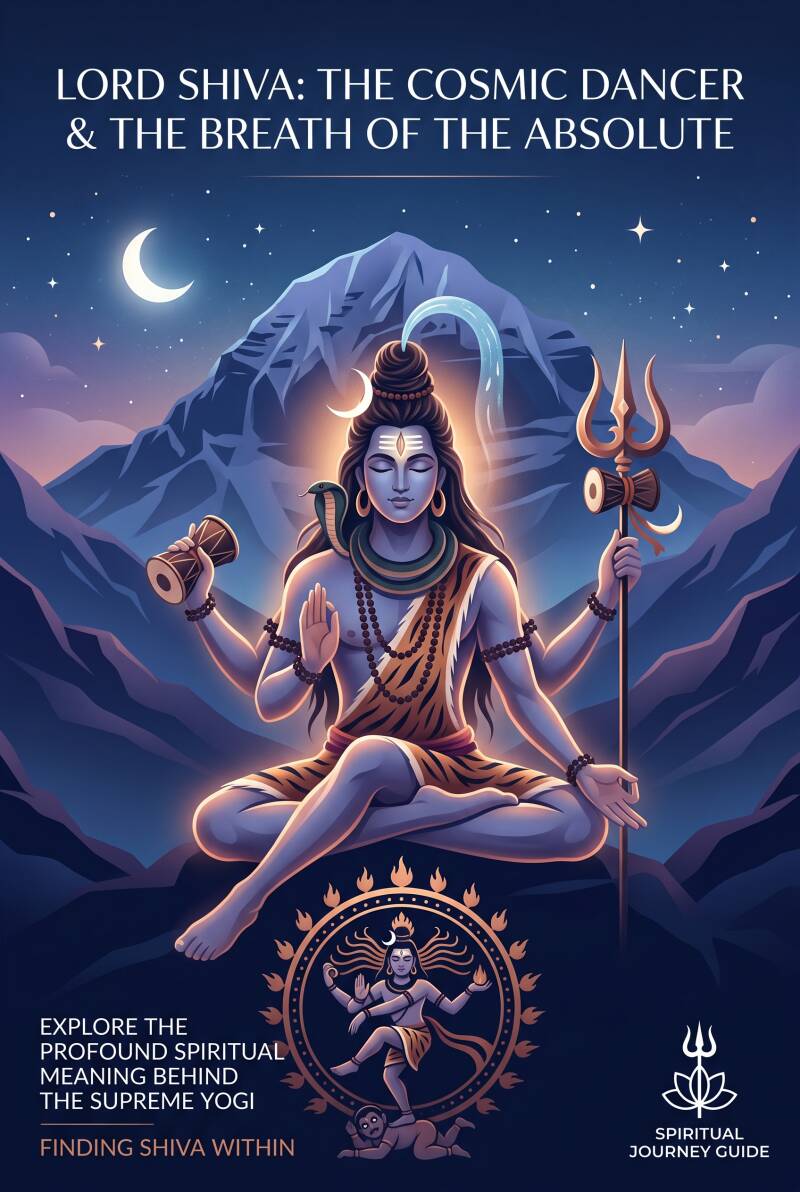
One of Shiva's most striking representations is that of Nataraja, the king of dance (Tandava). Depicted at the heart of a circle of fire, Shiva dances on the back of Apasmara, the demon of ignorance and forgetfulness.
-
The Circle of Fire (Prabha Mandala): It symbolizes the infinite cycle of time, creation, and cosmic destruction.
-
The Drum (Damaru) in his right hand: It represents the primordial sound, the first heartbeat that gave birth to the Universe, the creative vibration (Om).
-
The Flame in his left hand: It embodies the purifying fire that dissolves illusory forms and consumes the ego.
-
His raised leg and hand pointing to his foot: This is the ultimate refuge, indicating that liberation (Moksha) is accessible to anyone who frees themselves from material attachment.
This dance is not mere entertainment; it is the very movement of life, the ceaseless flow of universal energy (Shakti) that animates every atom.
2. The Supreme Yogi and the Third Eye
Unlike lavishly adorned gods, Shiva is often portrayed as a meditating ascetic, seated on a tiger skin atop Mount Kailash, his body smeared with sacred ash (vibhuti), with matted hair (jata) from which the Ganges flows.
The ash he wears reminds us of the vanity of material appearances: everything eventually returns to dust. At the center of his forehead shines the third eye. This spiritual eye is normally closed, but when it opens, it unleashes a beam of fire capable of reducing illusory desires, the ego, and ignorance to ashes. It symbolizes inner vision—the vision that allows one to see beyond the veil of Maya (the illusion of the phenomenal world).
3. The Indissoluble Bond with Shakti
On a spiritual and philosophical level, Shiva embodies pure, static, and immutable consciousness (Purusha), while his consort, the goddess Shakti (in her forms as Parvati, Durga, or Kali), embodies active energy, the creative force of the universe.
The one cannot exist without the other. Without Shiva's consciousness, Shakti's energy is chaotic; without Shakti's energy, Shiva's consciousness is inert. Their mystical union symbolizes the perfect harmony of polarities within every human being: the union of the sacred masculine and feminine, of stillness and movement.
4. The Symbol of the Lingam: The Origin Without Beginning
Shiva is frequently worshipped in the form of the Lingam, a smooth, oval stone pillar. Far from reductionist interpretations, the Lingam represents the Infinite, the formless Absolute (Nirguna Brahman), the cosmic essence that has neither beginning nor end. It is the symbol of the source of all creation, a reminder that behind the multiplicity of the world's forms lies a single, indivisible reality.
Conclusion: Finding the Shiva Within
In Hindu spirituality, invoking or meditating on Shiva does not mean praying to a distant deity, but rather awakening the silent consciousness that resides deep within our own hearts.
Shiva teaches us the courage of letting go. He invites us to burn away our fears, attachments, and false certainties in the fire of consciousness, so that we may be reborn into our true nature: free, luminous, and eternal.
Add comment
Comments