


Shiva: The Dancer of Silence, the Flame of Rebirth
"In the beginning, there was neither void nor plenum, neither night nor day. Only a motionless, infinite presence, awake in the depths of Eternity. Then, the first drum echoed, and the Cosmos awoke to the Dance."
Prologue: The Enigma of the Mahadeva
Imagine a being who embodies every contradiction of Creation. A being capable of remaining in meditation for a thousand years, motionless as an icy mountain, and then, in a single bound, rising to dance with a fury that ignites the stars.
In the vibrant heart of India, he is called Mahadeva — the Great God. Yet for the modern mind, accustomed to strict boundaries between good and evil, life and death, Shiva is a baffling enigma. He is often labeled "The Destroyer," a title that instantly evokes dread or misunderstanding. Yet among those who contemplate his face, there is neither terror nor sorrow. There is a profound sense of peace, a sacred joy.
Why? Because in the worldview from which Shiva emerged, destruction is not the opposite of life: it is its secret breath. For a tree to grow new buds in spring, autumn leaves must fall and return to the earth. For a poet to compose a new verse, silence must succeed the spoken word. Shiva is that invisible force sweeping away what has served its time, opening the passage for tomorrow's light.
Chapter 1: The Breath of Time and the Great Cosmic Recycling
1.1. The Trimurti or Eternal Balance
In the Hindu tradition, the Universe is not viewed as a static structure built once and for all, but as a play in three perpetual acts, embodied by the Trimurti (the Triple Form of the Divine):
-
Brahma is the morning breath, the architect who outlines forms, invents stars, forests, and living beings.
-
Vishnu is the midday light, the benevolent guardian who protects life, maintains harmony, and ensures that cosmic order (Dharma) does not collapse.
-
Shiva is the twilight and the starry night, the master of metamorphosis who dissolves weary worlds so that the cycle may begin anew.
Nothing in this universe can stagnate without decaying. Without Shiva's power of dissolution, the world would be condemned to endless accumulation, a material prison where old structures would suffocate new forms. Shiva is the great cosmic purifier, the divine gardener who prunes dead branches so that sap may flow with power once again.
1.2. The Great Dissolution: When Time Meets Eternity
Vedic cosmology does not conceive time as a straight line leading from a single beginning to a final end, but as a vast, endlessly turning wheel. The ages of humanity (Yugas) follow one another, from the purest to the darkest. When the Kali Yuga arrives — the age where ignorance, confusion, and discord reach their peak — the Universe exhausts itself.
It is then that Shiva steps onto the stage under his aspect of Pralaya (the Great Dissolution). In a surge of lucid compassion, he reabsorbs matter into its state of pure energy. Earth melts into water, water evaporates into fire, fire dies into the breath of wind, and wind dissolves into the silence of space. The world does not vanish into nothingness: it returns to the matrix, like a wave that calms to become the Ocean once more. Everything falls asleep, cradled by Shiva's silence, until a new desire to exist ripples through the Infinite.
1.3. Inner Destruction: Overcoming the Ego
While great cosmic dissolution may seem distant, Shiva's destruction takes place every day within ourselves. What does the fire of Shiva truly seek to destroy?
It does not seek to destroy our joy or our existence, but our illusions. It attacks the Ahankara — that pretentious inner voice that believes itself separate from the rest of the world, clinging desperately to possessions, titles, grudges, and fear of the future.
Viewing Shiva from this perspective transforms how we perceive life's trials. When a project collapses, when a certainty shatters into pieces, it is not a punishment: it is Shiva's hand breaking a shell that has grown too tight. He tears us away from the false security of habit to restore us to our true nature — vast, free, and immortal.
Chapter 2: Nataraja – The Dance That Makes the Stars Vibrate
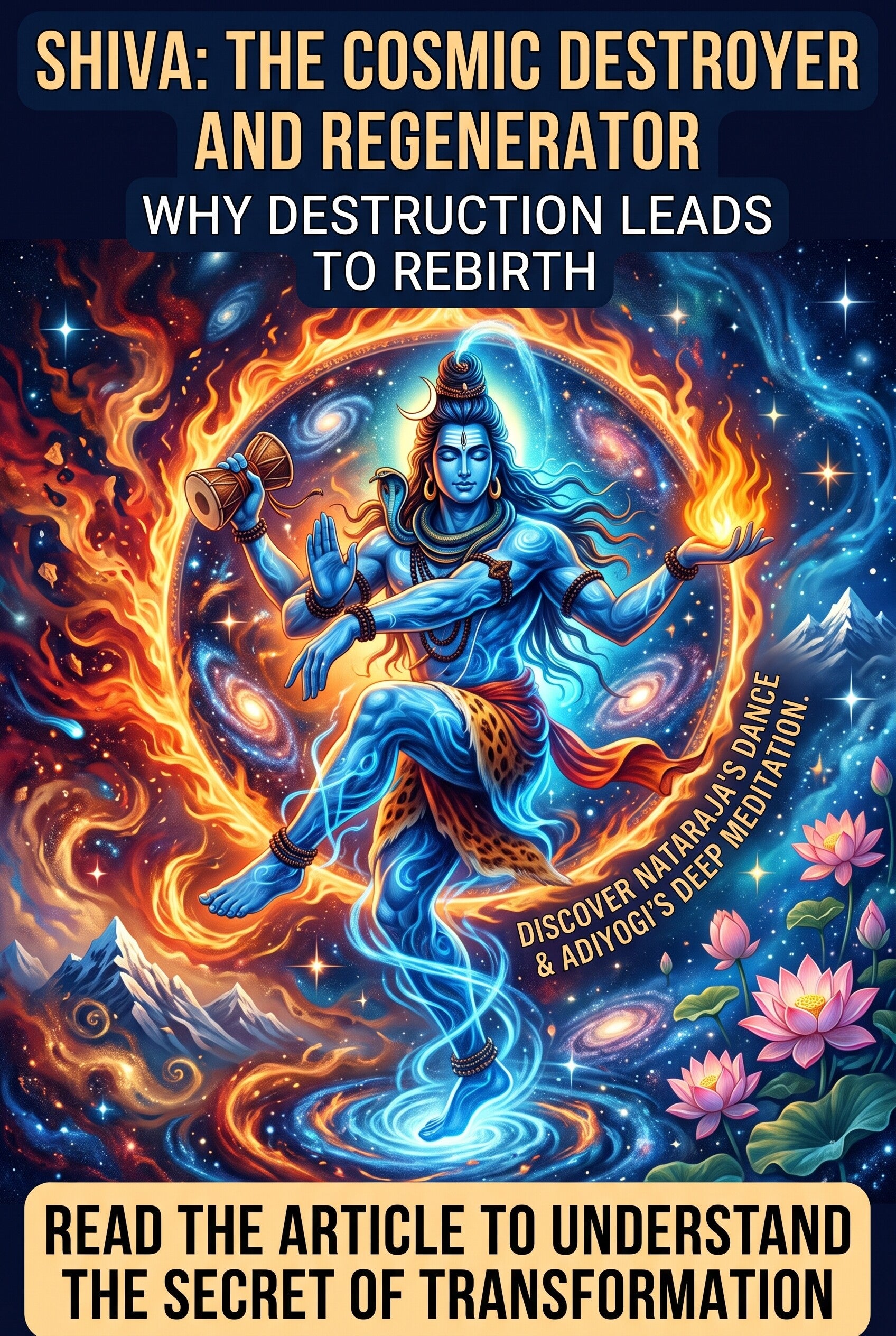
If there is one image that has captivated humanity for centuries, it is that of Shiva Nataraja, the Lord of the Dance. Imagine a figure sculpted in bronze, suspended in a movement of absolute grace, encircled by a ring of fire. This sculpture is not merely a work of art: it is a metaphysical poem, a complete map of how the Universe operates.
2.1. Ananda Tandava: The Ballet of Supreme Bliss
Shiva does not dance for entertainment. His dance is named Ananda Tandava, the Dance of Bliss. He dances at the very center of the human heart, in a secret sanctuary sages call Chidambaram — the space of pure consciousness.
Let us look closely at this legendary figure:
In his upper right hand, he holds the Damaru, a small hourglass-shaped drum. From this drum springs the world's very first vibration, the primordial sound from which matter, time, and space emerge. It is the initial spark, the heartbeat of Creation.
In his upper left hand, held in perfect balance with the drum, he carries Agni, the sacred flame. This fire is the power of dissolution that consumes the world at the end of time, but also the light that burns away our inner falsehoods. Creation and Destruction sit there, held in sovereign balance by the God's two hands.
His lower right hand is raised, palm open forward, in the universal gesture of Abhaya Mudra: "Fear not." In the midst of the cosmic whirlwind, as everything changes and fades around us, the Lord reassures us. Death is but a passage; change is but play.
With his lower left hand, he points to his raised foot, suspended in mid-air as an invitation to freedom. This foot, freed from earth's gravity, symbolizes spiritual liberation — the moment the soul detaches from the heavy burdens of this world.
Finally, beneath his right foot planted on the ground, Shiva crushes with a smiling firmness a small figure: the dwarf Apasmara. This dwarf embodies spiritual ignorance, mental sloth, and the amnesia of our divine nature. By stepping upon Apasmara, Shiva does not destroy a living being: he vanquishes the unconsciousness that prevents us from being fully awake.
2.2. The Quantum Echo: The Dance of Particles
In the twentieth century, when physicists began exploring the fascinating world of subatomic particles, they uncovered a breathtaking reality: at the most fundamental level, matter is not made of small solid objects, but of a field of energy in perpetual transformation. Particles are continually born, interact, annihilate, and are reborn in a frantic dance.
Physicist Fritjof Capra highlighted with wonder that ancient Indian sages had glimpsed this reality through meditation: matter is an uninterrupted dance of creation and destruction. It is no coincidence that at the heart of CERN in Geneva — the world's largest particle physics laboratory — a majestic statue of Shiva Nataraja stands before researchers. It serves as a daily reminder that modern science and ancient mythology gaze with the same awestruck eyes upon the very same cosmic mystery.
Chapter 3: The Ascetic of Mount Kailash – Silence and the Fire of Awakening
Leave behind for a moment the burning ring of the dancer Nataraja, and let your mind travel to the icy heights of the Himalayas. There, atop Mount Kailash, shrouded in mist and eternal snows, Shiva appears under a completely different face: that of the Solitary One, the motionless Ascetic absorbed in deep silence.
3.1. Adiyogi: The Birth of Yoga
In the Indian tradition, Shiva is Adiyogi, the very first Yogi ever to walk the Earth.
Legend tells that one day, swept into indescribable ecstasy, a mysterious being appeared upon the Himalayan peaks. At times he danced with wild fury; at times he became completely still, no longer breathing, becoming indistinguishable from the rock. Seven seekers of truth (the future Saptarishis, the seven great sages) sat near him, spellbound. They longed to understand the source of this absolute freedom.
For decades, the motionless being paid them no mind. Yet seeing their unshakeable dedication, he finally broke his silence. He did not speak to them of beliefs or dogmas, but imparted a method of surgical precision to explore human consciousness: the science of Yoga. He taught them how to master the breath, still the whirlwind of thoughts, and awaken the divine energy sleeping within the body.
3.2. Mount Kailash: The Unviolated Axis
In western Tibet stands a mountain of almost perfect pyramidal shape, draped in white ice: Mount Kailash. For millions of people, it is Shiva's earthly abode. A unique fact on our planet: while Mount Everest has been climbed hundreds of times, no human being has ever set foot on the summit of Kailash. It remains unviolated, preserved from any human footprint out of reverence for its sacredness.
On a spiritual level, Kailash represents the fixed pole of the world, perfect immobility in the eye of the storm. It reminds us that even when our daily lives are tossed by emotions, plans, and worries, there exists within us an unviolated space — an inner Kailash — where a peace reigns that nothing can disturb.
3.3. The Third Eye: The Fire of Lucidity
At the center of Shiva's forehead shines a vertical third eye, the Trinetra. While our two physical eyes look out at the external world and see only appearances — forms, colors, differences —, the third eye gazes inward, perceiving the invisible Unity connecting all things.
A famous legend recounts that one day, the gods sent Kamadeva, the charming god of desire and passion, to distract Shiva from his meditation and cause him to fall in love with the gentle Parvati. Kamadeva shot a arrow of fragrant flowers that brushed the ascetic's heart. Shiva's mind was momentarily disturbed. Irritated by this intrusion of illusion into the purity of his contemplation, Shiva gently opened his third eye. A ray of consuming fire blazed forth, and in a fraction of a second, the god of desire was reduced to a handful of ash.
This tale is not a lesson in severity, but a striking parable: when the light of full awareness awakens within us, all obsessive desires, compulsions, and artificial attachments are instantly burned away by the clarity of truth.
3.4. Sacred Ash: Remembering the Essential
Shiva does not dress in silk or deck himself in gold. He lives unclothed or wrapped in a tiger skin, his body completely smeared with sacred ash (Vibhuti), taken from cremation grounds where the deceased are burned.
Why does the supreme God choose to cover himself in ash? Ash is what remains when fire has consumed everything. It can no longer burn; it can no longer spoil. By covering himself in ash, Shiva addresses a poignantly honest message to every human being: "This physical body you care for with such devotion will one day end in ashes. Do not invest your entire soul in what is fleeting. Seek that within you which never burns."
Chapter 4: Shiva and Shakti – The Incorruptible Alliance
It would be a major mistake to imagine Shiva as a purely masculine power or a god isolated in his solitude. In Indian philosophy, Shiva does not exist without his equal, his lover, and his energy: Shakti.
In sacred traditions, this timeless relationship is reflected in geometric symbolism where Shiva is represented as an upward-pointing triangle—symbolizing pure, unyielding consciousness reaching toward the unmanifested—and Shakti as a downward-pointing triangle—representing creative energy, life, and divine power descending into form.
4.1. The Ocean and the Wave
To understand the relationship between Shiva and Shakti, the sages use a simple image:
-
Shiva is the Ocean in its unfathomable depths: calm, motionless, silent, carrying infinite potential within. He represents Pure Consciousness.
-
Shakti is the surface of the Ocean: the breeze, the leaping waves, the joyful foam, the storms, and the motion. She represents Manifested Energy.
Without Shakti, Shiva is a sleeping potential, unable to act or create. Ancient tantric texts even state with boldness: "Shiva without Shakti is Shava" (which means a lifeless corpse). Conversely, without Shiva, Shakti would be a wild fire, motion without direction or awareness. All Creation is the uninterrupted love dialogue between Consciousness contemplating and Energy dancing.
4.2. Ardhanarishvara: The Lord Who Is Half Woman
One of the most striking depictions in the Hindu pantheon is the figure of Ardhanarishvara. Imagine a statue split vertically down its exact center: the right side is an athletic man, his bare chest smeared with ash, his hair tied in a yogi's bun; the left side is a woman of breathtaking beauty, dressed in colorful silk, wearing gold bangles with an eye outlined in kohl.
This extraordinary image predates our modern reflections on gender and psychology by thousands of years. It proclaims that:
-
The Divine utterly transcends all our masculine or feminine categories.
-
Every human being, whether male or female, carries within a masculine polarity (structure, presence, stability, logic) and a feminine polarity (creativity, intuition, sensitivity, fluidity).
-
Spiritual maturity consists not in rejecting one or the other of these forces, but in marrying them within our own psyche.
Chapter 5: The God of a Thousand Faces – Legends and Compassion
Though he is the master of cosmic forces, Shiva is described in popular Indian stories with surprising closeness and tenderness. He is by turns the formidable warrior and the gentlest companion.
5.1. Neelakantha: Transmuted Poison
Long ago, legend says, the gods and demons joined forces to churn the vast Ocean of Milk in order to bring forth the elixir of immortality. But as the churning reached its peak, the ocean suddenly spat out a dark, toxic cloud: Halahala, a poison so devastating that a single drop could annihilate all life in the Universe.
Stricken with panic, gods and demons fled. Not knowing where to turn, they pleaded with Shiva to step in.
Shiva stepped forward without hesitation. He gathered the deadly poison in the palm of his hand and, in a gesture of infinite compassion, drank it to save the world. But Parvati, his wife, fearing for his life, gently pressed his throat to prevent the poison from reaching his stomach. The poison remained trapped in his throat, staining it an eternal midnight blue.
Thus Shiva earned the name Neelakantha, the Blue-Throated God. This legend carries a spiritual teaching of luminous beauty: when faced with negativity, hatred, or the "poison" of the world, the wise person does not seek to spit it back out at others, nor let it poison their own heart. They receive it with compassion, hold it in the throat — the center of expression — and transform it through the power of love.
5.2. Bholenath: Friend of the Humble and Outcast
While other deities sit in golden palaces and demand luxurious offerings, Shiva dwells upon the bare earth. He is affectionately nicknamed Bholenath, the Simple God, the Innocent One.
In mythological tales, Shiva is always the refuge for beings shunned by polite society: repentant demons, wandering spirits, strange creatures, injured animals, beggars, and outcasts. To touch Bholenath's heart, one needs no knowledge of Sanskrit nor worldly wealth: a simple leaf picked in the forest and poured upon his symbol with a sincere heart is enough to awaken his grace. He reminds us that true greatness lies not in grandeur, but in simplicity of heart.
5.3. The Shiva Lingam: The Form of the Unseen
If you enter a Shiva shrine in India today, you will not find, at the center of the dark inner sanctum, a statue carved with arms and a face. You will see a smooth, cylindrical stone set upon an oval base: the Shiva Lingam.
The word Lingam is often misunderstood. In Sanskrit, it simply means "sign," "mark," or "symbol." It is the cosmic egg, the simplest and purest form imaginable. The Lingam reminds the pilgrim that behind mythological images, stories, and names, Shiva is the Ultimate Reality: without beginning, without end, formless, beyond what words can describe.
Chapter 6: The Legacy of Shiva – Wisdom for Our Time
What can a god thousands of years old bring to our daily lives, paced by screens, speed, and 21st-century uncertainties?
6.1. The Grace of Letting Go
We live in a culture obsessed with control. We want to predict everything, secure everything, hold onto everything. But life regularly reminds us of its unpredictability.
Meditating on Shiva means learning serenity in the midst of change. It means understanding that when something ends — a job, a relationship, a stage of life —, it is not necessarily a disaster. It is space being freed so that something new can be born. Shiva teaches us not to cling to ruins, but to look with curiosity at the field of possibilities opening up.
6.2. Finding the Fixed Point in the Whirlwind
The modern world often resembles the frantic dance of Nataraja: everything moves fast, everything burns, everything transforms. If we seek stability in external events, we will be swept away like straws in a storm.
Shiva's ultimate teaching is to show us that we all possess, deep within, an unshakeable sanctuary: the silence of the mind, conscious presence. Like Mount Kailash remaining impassive under blizzards, we can learn to observe the movement of the world without losing our inner peace.
Epilogue: The Silent Gaze
In the final analysis, Shiva is neither a historical figure nor a distant deity perched in the clouds. He is the name ancient sages gave to that unfathomable mystery dwelling at the center of every chest.
He is the quiet awareness listening to your thoughts this very moment. He is the silence between two heartbeats, the pause between your inhalation and exhalation. He is that gentle strength reminding you that you are infinitely greater than your fears, vast beyond your failures, and more eternal than your memories.
When the wind of change blows through your life and old certitudes fly away, do not tremble. It is only Shiva passing by, dancing, to restore your freedom.
Glossary of Sacred Terms
-
Adiyogi: "The first Yogi." The title given to Shiva as the originator of the science of Yoga.
-
Abhaya Mudra: The gesture of the open hand meaning "Fear not," offering peace and security.
-
Ananda: Pure bliss or joy that depends on no external condition.
-
Damaru: The small hourglass drum whose rhythm creates the first vibration of the world.
-
Mahadeva: "The Great God," the name of love and reverence given to Shiva by his devotees.
-
Neelakantha: "The Blue-Throated God," in memory of the poison he swallowed to protect Creation.
-
Shakti: Creative energy, the dynamic power giving form and life to the Universe.
-
Vibhuti: Sacred ash smeared on Shiva's body, symbol of impermanence and ultimate purity.
Add comment
Comments