


Beyond Clichés: The Living Guide to Hindu Philosophy and Principles
If you think Hinduism boils down to colorful statues with multiple arms, sacred baths in the Ganges, or the sight of a sacred cow wandering through New Delhi traffic, get ready to see things differently. Welcome to one of the oldest, most fascinating, and most influential spiritual and philosophical traditions in human history.
Today, Hinduism is practiced by over one billion people worldwide. Yet, unlike Christianity, Islam, or Judaism, Hinduism has no single founder, no universal dogma enforced under threat of excommunication, no single holy book equivalent to the Bible or the Quran, and no central authority like the Vatican.
So how does a tradition over four thousand years old stay vibrant without rigid dogma? The answer fits in a single sentence: Hinduism is not a doctrine of mandatory belief, but a laboratory of spiritual experience and a pragmatic way of life.
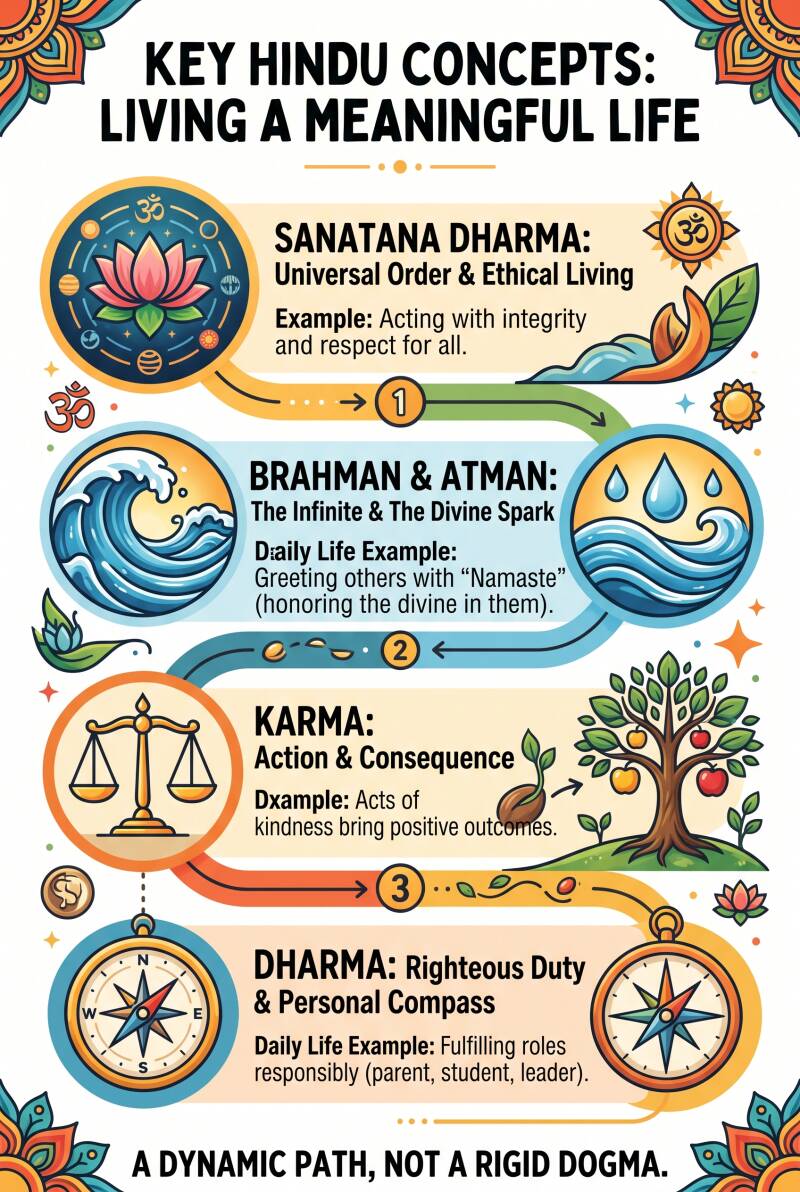
1. The Great Illusion of "Dogma": The Concept of Sanatana Dharma
In the Sanskrit language, the ancient sacred language of India, the word "Hinduism" did not even exist. The term was invented much later by outside observers to describe the practices of the people living near the Indus River.
Practitioners themselves refer to their tradition as Sanatana Dharma, which literally translates to "The Eternal Order," "The Universal Law," or "Perpetual Harmony."
A Revolutionary Freedom of Thought
To understand Sanatana Dharma, imagine a massive mountain. Traditional dogmatic religions often say: "There is only one path to climb the mountain, and if you take any other way, you are lost." Hinduism says the exact opposite: "The mountain is the same for everyone, but there are as many paths as there are human beings."
In this tradition, you can:
-
Believe in a single formless God.
-
Pray to dozens of different deities.
-
Consider all of nature to be divine.
-
Be skeptical, agnostic, or even atheist while practicing yoga and meditation.
What matters is not signing a blank check to an abstract doctrine, but the sincerity of your quest, your personal ethics, and how you treat the world around you.
2. The Fundamental Duo: Brahman and Atman
To explore Hindu thought without getting lost in jargon, we need to understand two essential concepts that form the backbone of its metaphysics: Brahman and Atman.
Brahman: The Ocean of Infinite Energy
Brahman is not an old man sitting on a cloud with a white beard. Brahman is the ultimate reality, pure consciousness, the uncreated matrix of energy that underlies the entire universe. It is what stars are born from, what keeps your heart beating, and what holds atoms together.
It is an impersonal, infinite force with no beginning and no end.
Atman: The Divine Spark Within You
Atman is your deepest essence, your immortal soul. It is not your body (which ages and dies), nor your mind (which changes its mind every five minutes), nor your ego (which always wants to be right). Atman is the silent, peaceful observer at the very core of your being.
A Concrete Everyday Example: The Wave and the Ocean
Look at a wave rising on the surface of the ocean. The wave might think: "Look at me! I am a big, unique wave, two meters tall, gliding fast, and I'm terrified of crashing onto the sand and disappearing!" Yet, if that wave takes a step back, it realizes it is nothing other than salt water. It has always been the ocean, it is made of the ocean, and when it crashes onto the shore, it doesn't die: it simply merges back into the ocean.
In Hindu philosophy:
-
The Ocean is Brahman.
-
The Wave is your Atman (your temporary individuality).
-
The Illusion of Separation is what causes our daily suffering.
How Does This Apply to Your Day?
When you are stuck in traffic or waiting in an endless checkout line at the supermarket and the person in front of you starts getting annoyed, the philosophy of Atman reminds you of something essential: beneath their stress, ego, and unpleasant reactions, that person carries the exact same spark of divine consciousness as you.
It is from this realization that the famous Indian greeting Namaste comes, accompanied by hands pressed together at the heart. Namaste doesn't just mean "hello," but literally: "The divine consciousness in me greets and honors the divine consciousness dwelling in you."
3. Karma: The Physics of the Soul and the End of Excuses
If there is one Sanskrit word that has crossed borders to become part of everyday language around the world, it is Karma. Unfortunately, it is often misunderstood.
Karma is not fate, nor divine retribution, nor a cosmic punishment handed down by an invisible judge.
The word Karma simply means "action." It is the universal law of cause and effect applied to morality, thoughts, and emotions. It is the spiritual equivalent of Newton's third law: every action brings an equal and opposite reaction.
How Does Karma Work?
Every time you think, speak, or act, you send a vibration into the world. This action leaves an impression in your mind (called a Samskara). By repeating an action, the impression deepens into a groove, the groove becomes a habit, the habit shapes your character, and your character crafts your destiny.
A Living Example of Karma in Everyday Life
Imagine two coworkers, Sarah and Mark.
Sarah approaches her day with suspicion. She spreads rumors, criticizes colleagues behind their backs, and constantly tries to take credit for team projects. What happens? Even if no one catches her red-handed immediately, Sarah creates an atmosphere of distrust around herself. Her colleagues become cautious around her, information stops reaching her, the mood turns tense whenever she enters a room, and she ends up feeling isolated and anxious. Her negative Karma wasn't sent from the sky: she wove it herself, thread by thread, through her own intentions.
Mark, on the other hand, decides to help an overwhelmed intern, takes the time to truly listen to a struggling colleague, and spontaneously shares credit for team successes. He fosters a spirit of cooperation and kindness. The day Mark faces a major roadblock on a project, three people step up without hesitating to help him. That is the rebound effect of his positive Karma.
Karma Is Not a Sentence; It Is Your Power
If your current situation is the result of past actions, the good news is that your future situation will be the exact result of the choices you make today! Karma removes the victim mindset and hands you back the keys to your own life. You are the sole architect of your destiny.
4. Dharma: Your Moral Compass and User Manual
If Karma is the law of cause and effect, Dharma is the rulebook. It is moral duty, right conduct, ethics, and alignment with the natural order.
Subtly, Hindu thought recognizes that Dharma is not a rigid list of ten commandments carved in stone that apply identically to everyone at all times. Hinduism recognizes the concept of Svadharma (personal Dharma). Your duty depends on who you are, your social role, your age, and your context.
Concrete Examples of Dharma by Role
-
A Student's Dharma: Show curiosity, study with discipline, respect teachers, and seek truth.
-
A Parent's Dharma: Protect and raise children with love, providing strong values to navigate the world.
-
A Doctor's Dharma: Treat patients without discrimination, show compassion, and serve life even when exhausted.
-
A Leader's Dharma: Make fair decisions for the common good rather than personal interest.
An Ethical Dilemma in Daily Life
Imagine you are a firefighter responding to a building fire. If you see someone trapped on the second floor of a burning building, your firefighter's Dharma asks you to run toward danger to save them, even at risk to your own life.
On the other hand, if you are a parent walking down the street with your three-year-old child and a building catches fire, your parent's Dharma asks you primarily to get your child to safety.
Same situation (a fire), but two entirely different ethical duties depending on your role and responsibility at that moment. Living by your Dharma means constantly asking yourself: "What is the most just, responsible, and aligned decision for global harmony in my current situation?"
5. Samsara: The Great School of Incarnations
In Hindu thought, human life is not a sprint from birth to death ending in a final judgment. It is a long marathon, or more accurately, a journey of learning.
Samsara refers to the perpetual cycle of birth, life, death, and rebirth. The individual soul (Atman) does not die when the physical body stops functioning. It simply changes vehicles, like changing worn-out clothes, to continue its spiritual growth.
The Video Game and Classroom Metaphor
Think of Samsara as an educational system or a multi-level video game:
When you enter first grade, no one expects you to solve differential equations. You learn the alphabet. If you fail a test at the end of the year, you don't burn in hell forever: you repeat the grade, review your lessons, and take the test again until you master the material.
In the same way, life experiences (successes, heartbreaks, loss, victories, and failures) are learning modules. As long as the soul holds unfulfilled desires, toxic attachments, or unlearned lessons of compassion, it returns to the school of Samsara.
Impact on How We View Time and Hardships
This perspective radically transforms your relationship with daily life:
-
Facing Failures: A business setback or a painful breakup is no longer a permanent catastrophe, but an intense lesson shaping your soul's maturity.
-
Facing Time: The anxiety of "running out of time" fades. The soul operates on a long, patient, and compassionate timeline.
6. Moksha: Liberation and the End of Illusion
If Samsara is the great school of life, Moksha is the graduation diploma.
Moksha is the ultimate liberation from the cycle of rebirth. It is the supreme moment when the individual soul fully realizes its true nature: it discovers that it was never separate from Brahman, that it is the ocean itself. It is the end of ignorance, the cessation of selfish suffering, and the doorway to unshakeable peace.
The Concept of Maya: The Cosmic Illusion
To understand why we haven't all attained Moksha yet, Hinduism introduces the concept of Maya. Maya is the veil of illusion that leads us to mistake temporary things for eternal realities.
A Vivid Example: The Cinema
Imagine sitting in a dark movie theater. The screen projects a gripping action movie: the hero is chased by villains, a car explodes, tension spikes. You grip your seat, your heart races, your palms sweat. You feel genuine fear.
Yet, what is actually happening in the room? A beam of light passes through film and hits a white cloth on a wall. There is no real car, no real fire, no real danger.
If someone suddenly turns on the house lights in the theater, the illusion instantly vanishes. You stop panicking and smile at your own reaction.
In Hindu philosophy, most of our daily dramas (fear of failure, obsession with social status, panic over aging) are projections on the screen of Maya. Moksha is the moment when the lights of awareness turn on: you keep living your life, but you no longer get trapped by the movie.
7. The Four Goals of Human Life: The Purusharthas
One of the most refreshing and realistic aspects of Hinduism is that it does not ask everyone to renounce their belongings, wear saffron robes, and meditate in a Himalayan cave. Quite the contrary!
Hinduism acknowledges that human existence is rich, complex, and unfolds in stages. That is why it outlines four legitimate and healthy goals for every human being: the Purusharthas.
1. Dharma (Righteousness and Ethics)
This is the foundation. Every pursuit of success or pleasure must be guided by moral awareness, respect for others, and justice.
2. Artha (Prosperity and Material Security)
Contrary to stereotypes associating Indian spirituality with total poverty, Hinduism clearly states that it is good, healthy, and necessary to seek professional success, earn a living, and secure financial comfort for one's family. Wealth is a life energy that allows one to build, support, and protect, provided it is earned honestly (following Dharma).
3. Kama (Pleasure, Love, and Sensual Joys)
Hinduism holds no guilt toward pleasure. Enjoying a delicious meal, falling in love, listening to music, admiring art, or playing with children are direct celebrations of creation's beauty. Kama is a noble life goal, as long as it does not turn into a destructive addiction.
4. Moksha (Spiritual Liberation)
This is the quest for deep meaning, spiritual awakening, and returning to what truly matters, which naturally gains importance as one matures and realizes that material objects alone cannot fulfill the human heart.
Perfect Balance in Modern Life
A balanced life according to the Purusharthas looks like this:
-
You work hard at an ethical job to provide a comfortable home and education for your children (Artha).
-
You take time to enjoy dinner with someone you love and travel to see wonderful landscapes (Kama).
-
You pay your taxes, help your neighbors, and remain honest in business (Dharma).
-
You dedicate twenty minutes each morning to meditation or philosophical reading to nurture inner peace (Moksha).
8. Monotheism or Polytheism? The Mystery of the Hindu Pantheon
Visiting a Hindu temple for the first time, one is amazed by the abundance of divine figures:
-
Brahma with four faces.
-
Vishnu with blue skin, holding a conch shell and a golden disc.
-
Shiva in his cosmic dance surrounded by flames.
-
Ganesha, the beloved elephant-headed deity.
-
Durga, the warrior goddess riding a tiger.
-
Saraswati, playing the sacred lute.
This raises the classic question: Is Hinduism polytheistic (many gods) or monotheistic (one God)?
The Prism and the Light Beam Metaphor
The precise answer is: It is a polymorphic monotheism (or panentheism).
Imagine a beam of pure, invisible white light. Pass that light through a crystal prism, and it instantly splits into a vibrant rainbow spectrum: red, blue, yellow, green, violet.
-
The original white light is Brahman (the Formless Absolute).
-
The different colors of the prism are the Deities (Devas and Devis).
The sages of India understood early on that most humans struggle to meditate on an abstract concept like "the Infinite" or "Universal Energy." We need faces, stories, symbols, and emotions to connect with the sacred.
Each deity in Hinduism embodies a specific facet of the universe:
-
Brahma: Represents the Creative force (the Big Bang, artistic inspiration).
-
Vishnu: Represents Preservation and Balance (health, social order, protection).
-
Shiva: Represents Transformation and Renewal (ending a cycle to make room for the new).
-
Ganesha: Represents Wisdom removing intellectual and psychological obstacles.
-
Lakshmi: Represents Abundance, beauty, and prosperity.
Ishta Devata: Freedom of the Heart
In personal life, every Hindu is completely free to choose their Ishta Devata (cherished deity)—the aspect of the Divine that resonates most with their heart:
-
A musician may naturally feel close to Saraswati, patroness of the arts.
-
An entrepreneur might turn to Ganesha when launching a new business.
-
Someone facing a major crisis might seek inner strength from Shiva or Durga.
All these prayers ultimately reach the same single source. A famous verse from the Rig Veda, one of humanity's oldest texts, summarizes it perfectly: "Truth is One, but the wise call It by many names."
9. Paths of Practice: The Four Yogas
How does this philosophy express itself in daily life? Through the practice of Yoga.
In the West, "yoga" often brings to mind a fitness class stretching on a mat in trendy clothes. But in Indian tradition, Yoga comes from the Sanskrit root Yuj, meaning "to yoke" or "to unite." Yoga is the art of uniting individual consciousness with universal consciousness.
Since human beings have different temperaments, Hinduism offers four main paths of Yoga:
1. Karma Yoga: The Path of Unselfish Action
This yoga is for people of action, builders, and volunteers. It consists of doing your best in your work and duties without being obsessed with selfish outcomes or praise.
Everyday Example: A chef preparing a meal with love and care—not just for a 5-star review, but simply to offer joy and wholesome food—is practicing Karma Yoga.
2. Bhakti Yoga: The Path of Devotion and Heart
This is the yoga for emotional, artistic, and mystical souls. It involves prayer, chanting mantras, celebrating beauty, and unconditional love for the Divine and humanity.
Everyday Example: Singing joyfully in your car with deep gratitude for simply being alive, or marveling at a sunset as a signature of the sacred.
3. Jnana Yoga: The Path of Knowledge and Discernment
This is the yoga for intellectuals, philosophers, and analytical minds. It uses deep reflection, study, and direct inquiry to pierce through mental illusions ("Who am I really beneath my social roles?").
Everyday Example: Observing your own angry thoughts during an argument and realizing: "Wait, I see anger rising, but I am not that anger. I am the awareness observing it."
4. Raja Yoga: The Path of Meditation and Mind Control
This is the royal yoga codified by the sage Patanjali. It combines physical postures (Asanas), breathing exercises (Pranayama), and deep meditation (Dhyana) to calm the mind.
Everyday Example: Sitting quietly each morning for fifteen minutes, focusing on your breath, and letting thoughts pass like clouds in the sky.
10. Everyday Gestures: Living Hinduism
To see how vibrant this tradition is, let's look at how it shapes a practitioner's daily routine.
Home Puja Ritual
Most Hindu homes feature a small sacred space or altar. In the morning, before starting the day, family members perform a Puja. They light a small oil lamp (symbolizing knowledge dispelling ignorance), burn incense, and offer a fresh flower or fruit. It is a simple moment of connection and gratitude.
Ahimsa: Sacred Respect for All Life
Ahimsa is the supreme ethical principle of non-violence toward all living beings. This principle is why India is home to the world's largest vegetarian population. The idea is simple: if we can live healthy lives without causing harm or death to innocent creatures, why not choose compassion?
The Sacred Cow
Visitors are often intrigued by the status of cows in India. The cow is not "worshiped as a god," but honored as a symbol of Mother Earth. She provides milk, assists in agriculture, and asks for almost nothing in return, embodying selfless generosity.
Summary: What Hinduism Offers to the Modern World
In a fast-paced world often filled with stress, materialism, and polarization, Hindu philosophy offers a profound breath of fresh air:
-
Frees you from the fear of failure: Life is a great school. Mistakes are lessons, not eternal condemnations.
-
Restores personal responsibility: Through Karma, today's thoughts build tomorrow's freedom.
-
Celebrates diversity: We don't all need to think alike to live in harmony. Everyone follows their own Dharma.
-
Reconnects us with nature: We are not dominant rulers exploiting the earth, but threads of the same living tapestry embraced by Brahman.
Ultimately, Hinduism invites us to lift our eyes above daily worries and remember our true identity: we are not human beings having an occasional spiritual experience, but immortal spiritual beings having a temporary human experience.
Add comment
Comments