


The Day I Discovered Sophrology: Between Breath of Life, Mindfulness, and the Wisdom of My Cat Cassie
Introduction: The Call of Calm in the Storm of Daily Life
There are days that mark an invisible turning point in a lifetime. Ordinary days when, completely unexpected, a simple step or a chance reading opens a door that you will never close again. For me, that day was the day of my first encounter with sophrology.
At that time, my mind felt like a train station during rush hour: thoughts rushed in and out, shouting and colliding in a permanent hubbub. Stress had settled in like an unwanted roommate, dictating my heart rate and tightening my shoulders to the point of pain. I knew I had to find a way out, a breathing space in both a literal and figurative sense.
So, guided by a vague intuition, I turned to a discipline I was hearing more and more about. Yet, I must admit, my first reaction was tinted with a certain skepticism or, at least, a hasty simplification. To me, sophrology was just another synonym for mindfulness meditation—simply another trend of sitting cross-legged waiting for time to pass. I thought to myself: "It's the same thing, you close your eyes and try to think of nothing."
What a mistake! This initiatory journey not only taught me to distinguish between these two wonderful practices, but it above all revealed to me the unsuspected power of breathing—our most powerful yet most neglected regulation tool. And in this adventure of reconnecting with myself, I was not alone. My cat Cassie, with her extraordinary feline sensitivity, became my practice companion, my barometer of serenity, and sometimes even my quietest and most effective guide.
Chapter 1: The Initial Confusion – Sophrology and Mindfulness, Two Different Sisters
When you start out in the field of well-being, it is extremely easy to confuse different approaches. Mindfulness meditation and sophrology do share a common goal: bringing you back to the present moment and soothing the mind. However, their roots, methods, and philosophies differ greatly.
Mindfulness: The Art of Pure Observation
Mindfulness, popularized in the West by medical professor Jon Kabat-Zinn in the 1970s, draws its sources from Eastern meditation traditions. It is a state of mind, a posture of life.
Practicing mindfulness means stepping into the role of a neutral observer. You sit, close your eyes (or keep a soft gaze resting in front of you), and observe what is there: the thoughts crossing your mind, bodily sensations, surrounding sounds, rising emotions. The golden rule is non-judgment and unconditional acceptance. If a stressful thought arises, you do not try to chase it away; you simply observe it rise, persist, and then fade away like a cloud in the sky. There is nothing to achieve, nothing to change, nowhere to go. It is a pure contemplation of existence.
Sophrology: An Active Pedagogy of Consciousness
Sophrology, on the other hand, was born in 1960 within a medical environment in Spain. Its founder, the neuropsychiatrist Alfonso Caycedo, was looking for a very gentle method to help his patients regain harmony and better manage their psychological and physical balance.
He traveled the world and gathered the best of Western approaches (clinical hypnosis, phenomenology, progressive relaxation, autogenic training) and Eastern practices (yoga, Zen meditation). The word "sophrology" actually comes from ancient Greek: Sôs (harmony, balance), Phrên (consciousness, mind), and Logos (study, science). It literally means "the study of consciousness in harmony."
Unlike mindfulness, which is purely contemplative, sophrology is resolutely active and goal-oriented. It uses three fundamental tools:
-
Controlled breathing (to oxygenate the body and send a signal of calm to the brain).
-
Muscle relaxation (through gentle body movements called "dynamic relaxations").
-
Positive mental suggestion (through guided visualizations using the voice).
In sophrology, we do not just observe stress; we act on it in a concrete way. We use movements to release physical tension, we voluntarily modify our breathing rhythm to calm the nervous system, and we project positive images into our minds to program our brains for calm, confidence, or the success of a test or project. It is a true education of consciousness.
Why This Distinction Changed My Vision
Understanding this difference was a real breakthrough for me. Where mindfulness sometimes left me frustrated—because my hyperactive mind refused to stay still and simply "observe" the chaos of my thoughts—sophrology offered me a framework of action. By giving me simple movements to do, specific breaths to guide, and pleasant images to build, it channeled my undisciplined mind. It proved to me that I could be the actor of my own peace.
Chapter 2: Breathing, Our Forgotten Superpower
If there is one area where sophrology excels and connects with my personal passions, it is breathing. We breathe about 20,000 times a day completely automatically. It is such a natural act that we forget how much it rules our physical and emotional state.
Yet, breathing is the only vital function (unlike our heartbeat or digestion) over which we can exercise conscious, voluntary control. It is our internal remote control for regulating our stress.
The Physiology of Calm: The Autonomic Nervous System
To understand the impact of the breathing techniques I discovered in sophrology, we need to take a quick look at biology. Our autonomic nervous system is divided into two main branches:
-
The Sympathetic System (the accelerator): This activates in times of stress, effort, or surprise. It speeds up the heart and prepares the body for action.
-
The Parasympathetic System (the brake): This is the system for recovery, relaxation, and rest. When activated, the heart slows down, muscles relax, and the mind quiets.
The fastest and most effective way to stimulate the parasympathetic system is to lengthen your exhalation. When we exhale deeply and slowly, we stimulate the vagus nerve, the cornerstone of our soothing system. Our brain instantly receives the message: "Everything is fine, there is no danger, you can relax."
My Favorite Breathing Techniques from Sophrology
Throughout my sophrology practice, I have developed a real passion for breathing exercises. Here are a few that I use regularly:
1. Abdominal Breathing: Returning to the Source
This is the natural way babies and animals breathe, but also the one we lose under the influence of stress, adopting a high and shallow chest breathing instead.
-
The Technique: Lying down or sitting, I place one hand on my belly and the other on my chest. Breathing in through my nose, I gently inflate my belly like a small balloon, keeping my chest still. Breathing out through my mouth, I let my belly deflate naturally.
-
The Benefits: It releases the diaphragm (the main breathing muscle, often blocked by anxiety) and brings an immediate sense of grounding and safety.
2. Box Breathing (Respiration au Carré)
This technique is incredibly effective for refocusing the mind in just a few cycles.
-
The Technique: It consists of four phases of equal duration (usually 4 seconds each):
-
Inhale through the nose while counting to 4.
-
Hold the breath (lungs full) while counting to 4.
-
Exhale slowly through the mouth while counting to 4.
-
Hold the breath (lungs empty) while counting to 4.
-
-
The Benefits: By forcing the mind to focus on the counting and the breath, it cuts off racing thoughts and instantly regulates the heart rate.
3. Sophro-Displacement of the Negative (SDN)
This is a classic sophrology exercise to clear away physical and psychological tension accumulated after a long day.
-
The Technique: Standing or sitting, I inhale deeply through my nose while becoming aware of my tensions (fatigue, nervousness, worries). I hold my breath for a few seconds while gently tensing all my muscles (from my face down to my feet), then I exhale sharply through my mouth, releasing my whole body at once and imagining throwing all the negative energy far away from me.
-
The Benefits: It is a true safety valve to release a build-up of overwhelming emotions.
Chapter 3: Cassie, the Zen Cat or the Miracle of Mirror Neurons
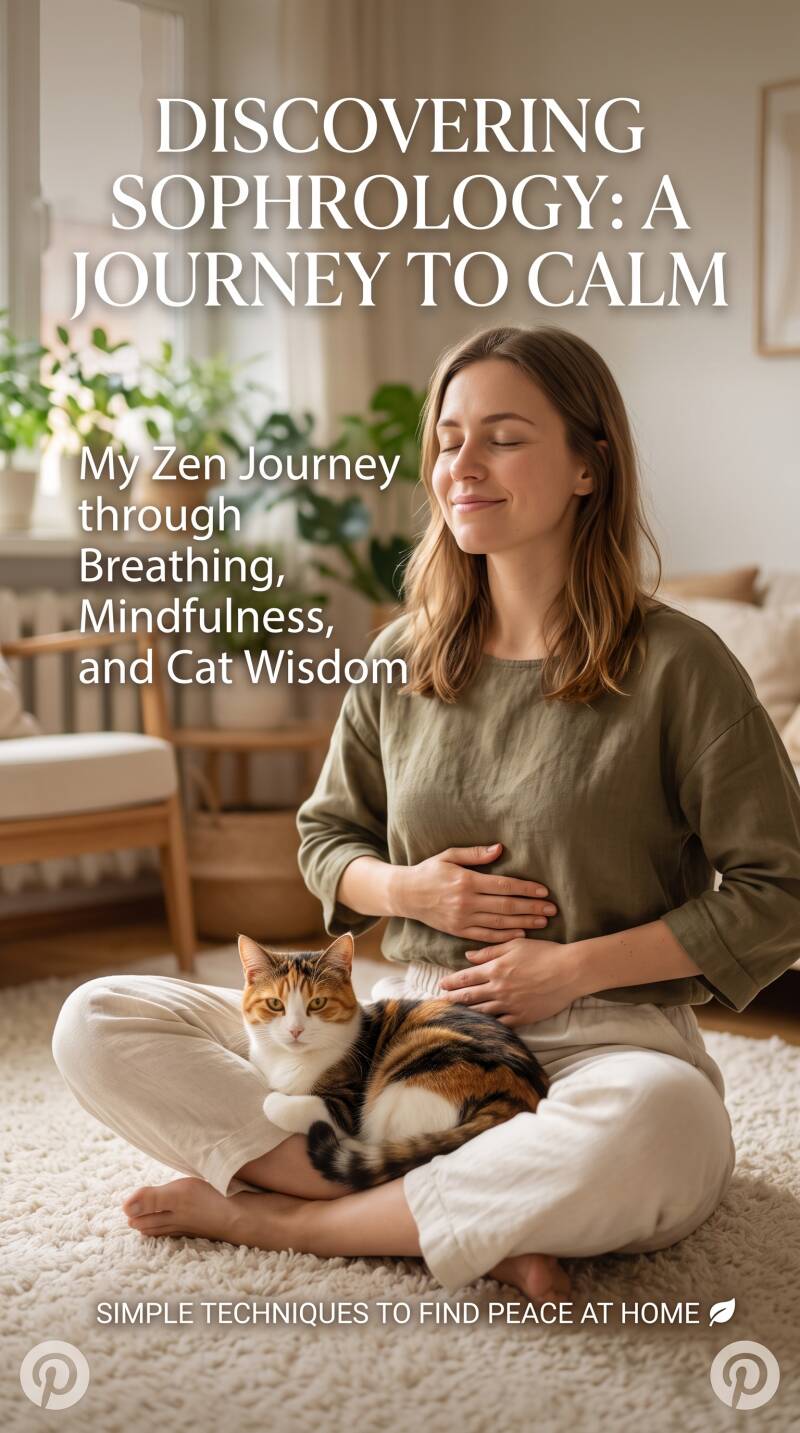
This is where the story takes a more intimate and magical turn. It is often said that animals are highly sensitive to our changes in mood. My cat Cassie is living proof. Cassie is a three-colored cat with golden eyes, gifted with a calm but very observant personality. Before I started sophrology, our relationships were affectionate, but she would sometimes keep her distance when I was restless.
The Emergence of the Ritual
The change happened during my very first home practice sessions. To practice sophrology, I usually set myself up on a comfortable mat on the living room floor. As soon as I started to settle down and close my eyes, I would see Cassie slowly approach.
As soon as I began my deep abdominal breathing, Cassie would come and settle right next to me, or even directly on my belly, where my hand measured the rise and fall of my breath. She would lie down, close her eyes in turn, and start purring in a very soft, steady tone.
Synchronization of Breaths and Purr Therapy
Pets, and cats in particular, have an incredible sensitivity to our breathing rhythm and our state of relaxation.
When I practice controlled breathing, my heart rate slows down. My muscle tensions fade. For Cassie, these are signs of absolute safety. She senses that my body has become a haven of peace, free of any tension.
An incredible phenomenon of synchronization then took place. Placing her head near me, I realized that Cassie’s breathing adjusted to mine. She slowed down her breath to match my slow breathing rhythm.
Even better, her purring acted as a natural relaxant. The vibrations emitted by a cat's purr sit at low frequencies (usually between 20 and 50 hertz). These frequencies have soothing virtues for humans: they reduce stress, promote relaxation, and help you feel good.
The warmth of her body on my belly helped me really feel my abdominal breathing. With each inhalation, I felt her gentle presence rise; with each exhalation, I felt her sink back down. Her presence turned a simple session into a moment of sharing and deep connection with nature.
Chapter 4: The Methodology of Sophrology – Beyond the Simple Breath
While breathing is the gateway to sophrology, the method goes much further. To understand why it has brought me so much, it is interesting to explore its key concepts.
The State of Deep Relaxation: At the Frontiers of Consciousness
One of the secrets of sophrology's effectiveness lies in using a very special state of consciousness: the state between wakefulness and sleep.
In this transition zone, our body is deeply relaxed, and our mind is particularly receptive and calm. Worrying thoughts gently fall asleep to make room for imagination and positive feelings.
It is in this state that we use the voice to guide positive visualizations. Because we are calm, images of success, nature, or confidence anchor deeply within us, helping us approach daily life with much more reassurance.
The Principle of Positive Action
Another pillar of sophrology is the principle of positive action. It states: "Any positive action directed towards our mind has a positive impact on our entire being."
In our daily lives, we sometimes tend to focus on what is going wrong (bad grades, arguments, fatigue). Sophrology proposes to train our minds to focus on the positive: feeling the parts of our body that are doing well, remembering a joyful moment, or imagining ourselves succeeding in a project. This reinforces our optimism and well-being.
Chapter 5: Practical Guide – Your First Steps in Sophrology at Home
To allow you to experience these benefits at home, here is a simple auto-sophrology protocol, very easy to carry out. If you have a cat or a dog, let them stay with you if they want!
Step 1: Getting Comfortably Settled
Choose a quiet place where you won't be disturbed for about 10 to 15 minutes. Sit on a comfortable chair, an armchair, or lie down on a cozy rug. You can use a blanket if you worry about getting a little chilly while relaxing.
Step 2: Releasing the Body
Gently close your eyes.
-
Take a quiet breath in through your nose, then blow gently out through your mouth.
-
Let your shoulders drop and relax.
-
Relax the muscles in your face: loosen your jaw, relax your eyelids and your forehead.
-
Feel all the contact points of your body with the surface beneath you (your back, legs, feet).
Step 3: Following the Rhythm of Your Breath
-
Place a hand on your belly.
-
Inhale through your nose, feeling your belly gently rise under your hand.
-
Exhale through your mouth, feeling your belly slowly sink.
-
Do this several times, at your own pace, without forcing. Focus entirely on this back-and-forth movement, like a calm wave.
Step 4: Visualizing Your Favorite Landscape
In this relaxed state, imagine a real or imaginary place where you feel perfectly good and safe (a peaceful beach, a green forest, a cozy cabin, or your bedroom).
-
Observe the beautiful colors of this landscape.
-
Listen to the pleasant sounds (the gentle wind, birds singing, running water).
-
Feel the calm settle into every part of your body. Enjoy this moment of serenity for a few minutes.
Step 5: Gentle Return
-
Take a deep, dynamic breath in through your nose and blow out through your mouth to wake up gently.
-
Begin to move your fingers and toes slightly.
-
Stretch your arms, your legs, yawn if you wish.
-
And when you feel ready, gently open your eyes, keeping this calm inside you for the rest of the day.
Chapter 6: Concrete Benefits on My Daily Life
Integrating sophrology and breathing into my daily life changed many things for me, and did so very quickly:
Better Emotional Management
Before, when faced with a stressful situation or a setback, I reacted immediately with a lot of anxiety or impatience. Today, I use my breathing to take a moment of pause. This allows me to find my calm and respond in a more serene and constructive way.
Easier and Restorating Sleep
At night, I used to toss and turn in bed thinking about everything I had to do the next day. By practicing abdominal breathing or box breathing directly at bedtime, I manage to soothe my mind. Falling asleep happens much faster and my sleep is much better, often accompanied by Cassie who comes to purr nearby.
Better Physical Health
Through these techniques, I have learned to listen to my body and release my shoulders or jaw as soon as I feel small tensions setting in during the day. This prevents me from accumulating fatigue and helps me stay in great shape.
Chapter 7: Cassie, the True Spiritual Master of the House
By observing my cat Cassie live her daily life, I realized a surprising truth: animals naturally embody serenity and the present moment without needing to make any effort!
Living the Present Moment
Watch a cat observe a tiny feather or bask in the sun. They are completely focused on what they are doing. They do not worry about the past or the future, they simply enjoy the present moment with perfect attention. This is a wonderful model of mindfulness!
Balancing Action and Rest
A cat manages its energy extraordinarily well. They know how to relax completely, their body fully limp, then pounce to play with enthusiasm, before instantly returning to a state of great calm. They respect their need for rest. Cassie reminds me every day how important it is to allow ourselves small breaks to recharge our batteries.
Conclusion: Breathing to Live Better, Together
The day I discovered sophrology, I was simply looking for a method to relax. I found much more: a path of connection with myself, based on respect for my body and my mind.
Breathing has become my anchor, a simple, free, and always available tool to find serenity in an instant.
And in this journey, sharing these moments of calm with my cat Cassie made the experience even more beautiful. She reminds me by her simple presence that serenity is meant to be shared and that well-being is within everyone's reach, one breath at a time.
Add comment
Comments