


The Breath of the Vajra: Wisdom and Mysteries of Tibetan Buddhism
The Call of the Summits: Beyond the Clouds, the Dwelling of the Mind
Dawn is still but a promise of pale gold behind the titanic silhouettes of Ladakh. At nearly four thousand meters above sea level, the air is so pure it seems to burn the lungs with an almost painful clarity. Suspended on the flank of an ochre rock cliff, Thiksey Monastery awakens in a shiver of frost. A scent rises gently from the inner courtyards: it is the resinous, sharp, and purifying fragrance of juniper being burned in clay censers to greet the new day.
Suddenly, the silence of the vastness is shattered. From the temple roof, two monks blow into dungchen, those telescopic copper horns whose deep, telluric sound seems to well up from the very depths of the Earth. This profound vibration rolls across the Indus Valley, pierces the mist, and strikes the chest of the traveler. This is not music; it is a call. A call to awaken from the long sleep of illusion.
In this fierce isolation, protected for centuries by the impassable barrier of the "Roof of the World", a unique spiritual tradition developed: the Vajrayāna. Far from being a simple religion made of dogmas and superstitions, Tibetan Buddhism reveals itself, to whoever pushes open its carved wooden doors, as a science of the mind of surgical precision. A cartography of human consciousness drawn by generations of contemplatives who explored the territories of the mind with the same rigor as geographers measuring the summits of the Himalayas.
Part 1: The Way of the Diamond and the Transmutation of the Mind
Original Buddhism teaches renunciation and the gradual extinction of desires. But in the heart of the high plateaus, where nature demands absolute resilience, a more radical path was born: the Vajrayāna, or the "Vehicle of the Diamond". The term Vajra refers to both the diamond, a symbol of indestructibility, and the thunderbolt, a symbol of the instantaneous clarity that shatters darkness.
The specificity of Vajrayāna lies in its revolutionary approach to human passions. Here, disturbing emotions—anger, attachment, jealousy, pride—are not rejected as sins or obstacles to be eliminated. They are envisioned as gigantic reservoirs of raw energy. The practitioner does not try to destroy the poison; they practice spiritual alchemy to transmute it into medicine. As a famous Tibetan metaphor says: the peacock consumes poisonous plants to give its plumage its most brilliant colors.
"Do not seek to cut the root of your emotions. Simply look at their profound nature, without following or rejecting them. Then, anger reveals itself as a mirror-like clarity, and desire as a wisdom of discernment."
— Padmasambhava (Guru Rinpoche)
In this alchemical quest, the figure of the Lama (the spiritual guide) is central. He is not a guru in the dogmatic sense, but a living mirror. Through his presence and realization, he shows the student their own Buddha-nature, still veiled by the impurities of ignorance. The oral transmission, from mouth to ear, from heart to heart, is the golden thread connecting today's masters to the yogis who meditated in the icy caves of Tibet over a thousand years ago. It is an uninterrupted lineage of lived experience, resistant to any disembodied theorization.
Part 2: The Art of the Ephemeral and the Beauty of Impermanence
In the dim light of a side chapel, the silence is barely disturbed by a regular, hypnotic metallic scraping. Four monks, sitting cross-legged, lean over a dark wooden table. Between their fingers, they hold chak-pur, thin, ridged metal cones filled with colored quartz sand. By gently rubbing a metal rod against the ridges, they let the sand flow grain by grain, drawing lines of microscopic precision.
They are creating a mandala.
For several days, even several weeks, these artists of the invisible will arrange millions of colored grains to compose a sacred geometry of dizzying complexity. Each color, each stylized deity, each cardinal gateway represents an aspect of the awakened mind. It is a total work of art, a two-dimensional projection of the cosmos and the human psyche reunified.
Then comes the moment of resolution. The mandala is finished. Its beauty is perfect, absolute. The monks gather one last time. And, with a gesture of solemn slowness, the master of ceremonies takes a silk brush and sweeps a diagonal line across the artwork, instantly dismantling the harmony of the patterns. In a few minutes, the colors blend, forming nothing but a pile of grayish sand, which will then be gathered in an urn and poured into the nearest river to disperse its blessings into the world.
This striking ritual is the living embodiment of Anitya, impermanence. Nothing lasts. Everything that is compounded is bound for dissolution. Contemplating the swept mandala, the modern spectator often feels a pang in their heart, an inward resistance. This is the manifestation of our attachment (upādāna), that futile attempt to fix what flows, to freeze the river water between our closed fingers. Tibetan Buddhism teaches us that suffering does not arise from change, but from our refusal to accept that change is the very law of life. There is an immense freedom in loving the beauty of things precisely because they are fleeting.
Part 3: The Secret Language of Symbols and Mantras
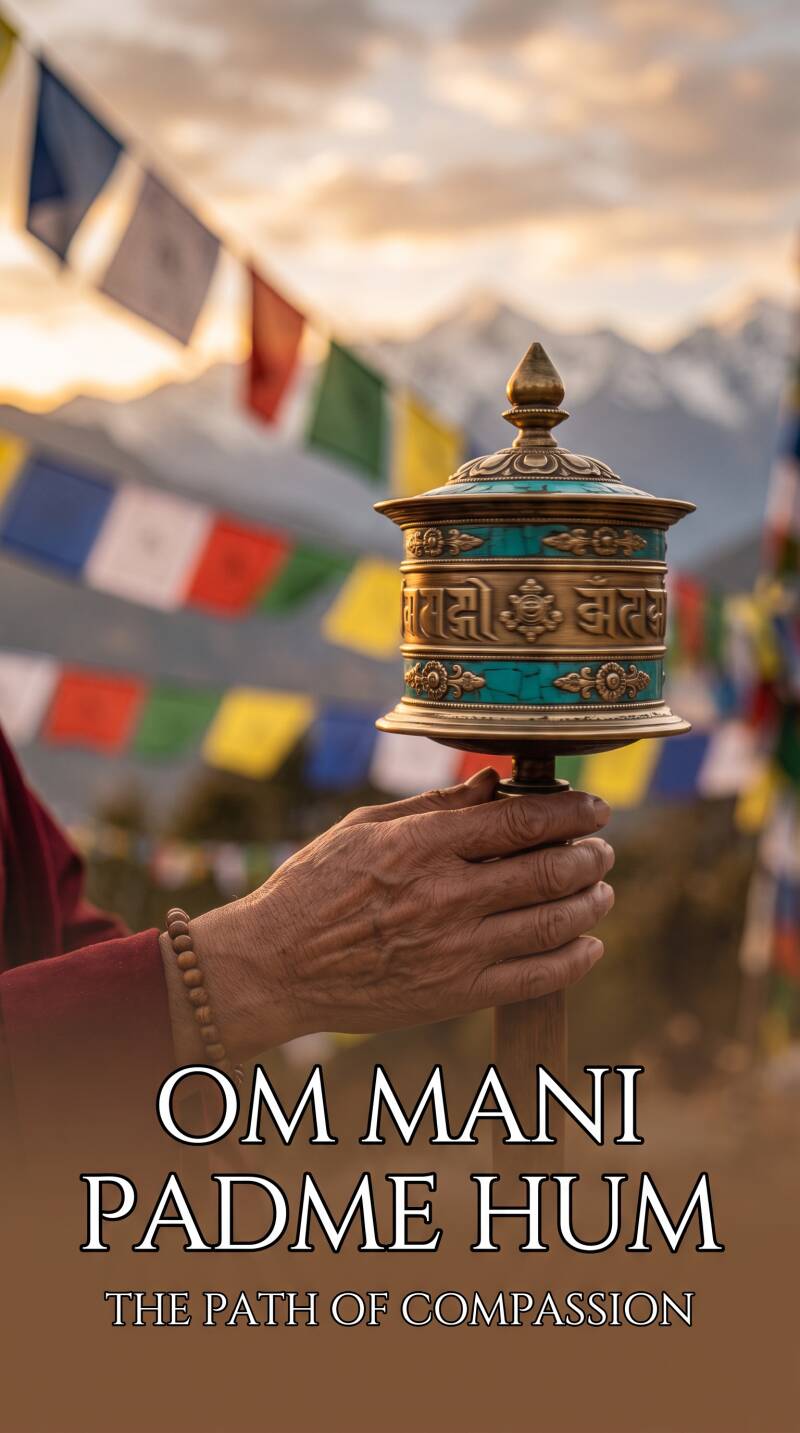
For whoever travels in Tibetan lands, the landscape itself seems to whisper a continuous prayer. Mountain passes are crowned with lungta, those blue, white, red, green, and yellow prayer flags flapping furiously under the onslaught of high-altitude winds. Printed on each piece of cloth are sacred texts and winged horses.
Contrary to popular belief, Tibetans do not send these prayers to an external deity to obtain favors. It is the wind itself that, by patiently wearing down the fabric, becomes charged with the vibration of the mantras and diffuses them through space, for the benefit of all sentient beings. The flags fray, lose their colors, and return to nothingness: they, too, teach impermanence while sowing compassion to the four corners of the horizon.
At the heart of this vibratory cosmology lies the mantra, the "protector of the mind" (manas-traya). The most famous of these, carved onto trailside stones (mani) and repeated by millions of pilgrims spinning their prayer wheels, is:
$$\text{Oṃ Maṇi Padme Hūṃ}$$
These are not simple magical syllables. Each sound resonates with a specific level of consciousness:
-
Oṃ purifies pride and opens the mind to spiritual generosity.
-
Maṇi ("the jewel") represents the intention of awakening, love, and compassion.
-
Padme ("the lotus") symbolises wisdom, the realization of emptiness (Śūnyatā), that immaculate flower that grows in the mud of our illusions without ever being soiled by it.
-
Hūṃ represents the indivisibility of method (compassion) and wisdom.
To pronounce this mantra is to tune one's own mind to the fundamental frequency of the universe, which Vajrayāna identifies with universal compassion.
Part 4: Taming the Shadow (The Art of Tibetan Meditation)
In the Western imagination, meditating is often equated with achieving a flat calm, a sort of woolly mental void where nothing stands out anymore. The Tibetan tradition sweeps this illusion away with vigor. The human mind is comparable to a wild waterfall: trying to stop it by force is not only useless, but dangerous.
Tibetan meditation, through the practices of Shinay (calm abiding) and Lhaktong (insight), consists of sitting at the edge of the waterfall. It is not about stopping the water, but about ceasing to drown in it. We observe the flow of thoughts, emotions, and memories without judging them, without clinging to them, and above all without identifying with them. If a thought of anger arises, we do not fight it; we simply observe it rising, shining for a moment, then dissolving into the space of consciousness, like a drawing traced on water.
"Thoughts arise from the mind and are reabsorbed back into it, just as waves rise from the ocean and return to it. The ocean remains the ocean, no matter how high the waves."
— Dilgo Khyentse Rinpoche
This introspection is by no means a selfish withdrawal into oneself. It is always accompanied by the compass of Bodhicitta, the mind of awakening, and Karuna, active compassion. To meditate, in Tibetan Buddhism, is to train oneself to become a refuge for others. Personal realization has no meaning unless it is put at the service of liberating all sentient beings from suffering. Without compassion, wisdom is sterile; without wisdom, compassion is powerless.
Conclusion: Bringing the Silence of the Peaks into the Clamor of the World
Let us leave the wind-swept heights of Tibet for a moment and return to the heart of our cities of concrete and glass, where time accelerates, screens saturate our attention, and anxiety has settled in as a permanent background noise. What message does the wisdom of the Vajra have to offer our weary modern world?
It reminds us that the true monastery is not made of stone, but of inner silence. We do not need to flee to the Himalayas to find peace. The Himalayas are within us. Every time we take a deep breath in the middle of a chaotic day, every time we accept that a project or a relationship is changing shape without trying to hold onto the past, every time we choose kindness in the face of aggression, we spin our own inner prayer wheel.
Tibetan wisdom invites us to turn our gaze inward. The peace we desperately seek outside, in the accumulation of objects, status, or experiences, is already there, tucked away in the space between two thoughts, beneath the tumult of our cluttered desires. It waits, changeless and vast like the blue sky hidden behind the storm.
"Happiness is not something that is acquired; it is a skill that is cultivated, day after day, by learning to look at our own mind with gentleness and clarity."
— The 14th Dalai Lama
As the sun sets over Ladakh, casting immense shadows over the mountains of salt and stone, the monks of Thiksey close the doors of the temple of the mind. But the wind continues to blow across the ridges, carrying with it the eternal song of the world: a silent invitation to let go, to breathe, and to simply be, right here, right now.
Add comment
Comments