
 Skip to main content


The Breath of Consciousness: The Ultimate and Living Guide to Sophrology Breathing
Imagine for a moment a free tool, available $24$ hours a day, instantaneous, capable of calming your heart rate, dissolving your anxiety, waking up your sleeping energy, or preparing you for a deep sleep. You have carried this tool within you since your first breath. It is your breathing.
Yet, most of us only breathe halfway. We "survive" on shallow chest breathing, restricted by everyday stress.
In sophrology, breathing is not a simple gas exchange; it is the central pillar of consciousness, the rudder of our emotions, and the engine of our vitality. This comprehensive guide invites you to rediscover the power of your breath through the Caycedian method. Get ready to inhale life and exhale the superfluous.
1. The Physiology of Breath: When the Body Anchors Itself
To understand why sophrology places such a high importance on breathing, let us take a quick journey beneath our rib cage.
The Diaphragm: The Invisible Conductor
The diaphragm is a dome- or parachute-shaped muscle that separates the chest cavity from the abdominal cavity.
-
Inhalation: The diaphragm contracts and moves downward. It pushes the abdominal organs down (causing the belly to expand) and creates a vacuum in the lungs to draw oxygen in.
-
Exhalation: The diaphragm relaxes and moves upward, expelling carbon dioxide.
In our fast-paced modern lives, this muscle can easily seize up. Under stress, we adopt shallow, clavicular chest breathing, which sends a permanent distress signal to our brain.
The Autonomic Nervous System: The Body's "Pause" Button
Our autonomic nervous system is divided into two main branches:
-
The Sympathetic System (The Accelerator): It activates in response to stress, increases heart rate, and prepares us for fight or flight. Fast, shallow breathing stimulates this system.
-
The Parasympathetic System (The Brake / Relaxation): It promotes digestion, recovery, sleep, and calmness. Slow abdominal breathing, especially when emphasizing exhalation, directly stimulates the vagus nerve, the great messenger of the parasympathetic system.
The Sophrological Key: By consciously taking control of our breathing, we regain control of our nervous system. We actively choose to switch from "survival" mode to "serenity" mode.
2. Mapping the Breath: The Three Breathing Levels
In sophrology, we learn to reoccupy our body through sensation. The first step is to explore the three levels of our respiratory system.
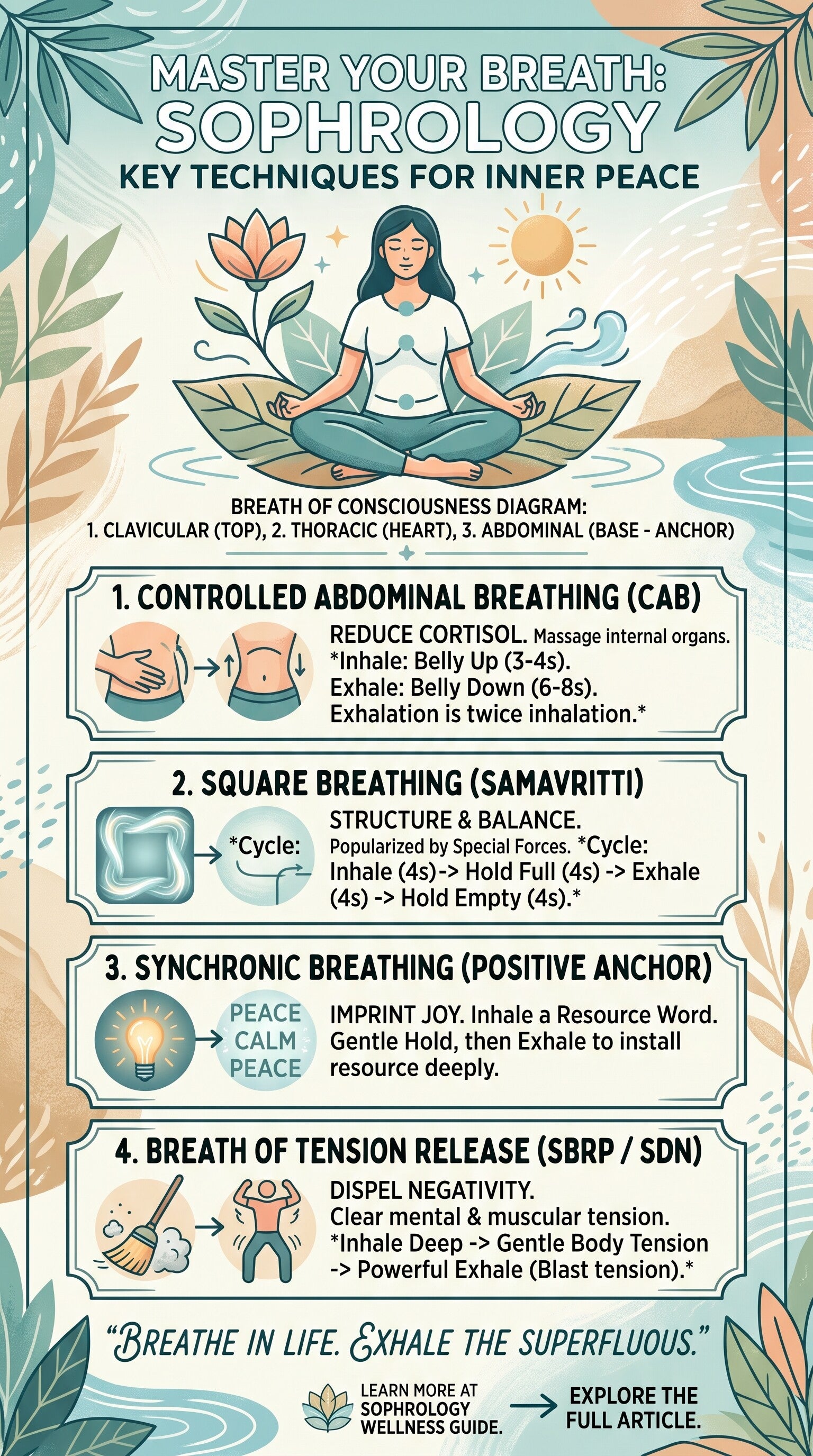
/\ <- 1. CLAVICULAR LEVEL (The Top - Stress / Speed) / \ /----\ <- 2. THORACIC LEVEL (The Heart - Emotions / Relationships) / \ /--------\ <- 3. ABDOMINAL LEVEL (The Base - Anchoring / Calm)
Level 1: Abdominal Breathing (The Base, Anchoring)
This is the natural breathing of infants and pets. It is fluid, calm, and deep.
-
Symbolism: Anchoring, inner security, returning to oneself, digesting emotions.
-
Physical Effect: Gentle massaging of internal organs, immediate reduction in cortisol (the stress hormone).
Level 2: Thoracic Breathing (The Heart, Emotion)
It takes place at the level of the ribs, which expand like accordion bellows.
-
Symbolism: Opening up to others, expressing feelings, but also the area where our anxieties settle (that familiar "chest tightness").
-
Physical Effect: Expansion of the rib cage, moderate cardiac stimulation.
Level 3: Clavicular Breathing (The Top, Urgency)
This is shallow breathing, the kind we use when running for a bus or during a panic attack. It mobilizes the top of the lungs.
-
Symbolism: Rapid action, vigilance, urgency.
-
Physical Effect: Rapid but incomplete oxygenation, tension in the neck and shoulders if it becomes chronic.
3. Mini Experimental Workshop: Awakening the Three Levels
Sit comfortably in a chair, with your back straight but not stiff, and your feet flat on the floor. Gently close your eyes.
Step A: The Belly Anchor
-
Place one hand flat on your belly button.
-
Inhale through your nose, letting your belly expand gently under your hand, as if inflating an invisible balloon.
-
Exhale slowly through your mouth, letting your belly fall naturally without forcing it.
-
Repeat this $5$ times. Feel the warmth of your hand rising and falling.
Step B: The Ribcage Accordion
-
Place your hands on either side of your ribs (around your chest).
-
Inhale, trying to push your hands outward with your ribs. Keep your belly as still as possible.
-
Exhale and feel your ribs contract.
-
Experience this lateral expansion for $5$ breath cycles.
Step C: The Shoulder Wings
-
Place your fingertips on your collarbones, just below your neck.
-
Inhale, directing the air all the way to the top; you should feel your collarbones rise slightly.
-
Exhale and let them sink back down.
-
Become aware of the speed and shallow nature of this breath.
4. The 4 Main Breathing Techniques in Sophrology
Caycedian sophrology uses targeted breathing to achieve different states of consciousness and release specific blockages. Here are the four fundamental techniques explained step-by-step.
Technique 1: Controlled Abdominal Breathing (CAB)
This is the universal stress reliever. It is used to center yourself in seconds before an interview, an exam, or simply to quiet an overactive mind.
-
The Protocol:
-
Inhale through your nose for a mental count of $3$ or $4$, expanding your belly.
-
Exhale through your mouth while pursing your lips slightly (as if gently blowing on a candle flame without blowing it out) for a count of $6$ or $8$.
-
The Golden Rule: The exhalation must always be twice as long as the inhalation ($1:2$).
-
-
Why it works: The prolonged exhalation strongly activates the parasympathetic system, instantly slowing down your heart rate.
Technique 2: Square Breathing (Samavritti)
Borrowed from Yoga and popularized by special forces (who use it under the name "Box Breathing" to maintain composure), this technique brings structure, focus, and balance.
The cycle of this breath is broken down into four phases of equal duration: Inhale (4s) ➔ Hold Full (4s) ➔ Exhale (4s) ➔ Hold Empty (4s).
-
The Protocol:
-
Phase 1: Inhale through your nose for $4$ seconds.
-
Phase 2: Hold your breath with full lungs for $4$ seconds.
-
Phase 3: Exhale through your mouth for $4$ seconds.
-
Phase 4: Hold your breath with empty lungs for $4$ seconds.
-
Repeat this cycle for $3$ to $5$ minutes.
-
-
Why it works: The breath-holding phases force the mind to focus solely on counting the time, cutting off the flow of intrusive thoughts (rumination).
Technique 3: Synchronic Breathing (Anchoring the Positive)
In this essential sophrology practice, we associate a positive word, image, or value with our breathing cycle. It is the art of imprinting an agreeable sensation into our cells.
-
The Protocol:
-
Choose a "resource" word (e.g., Calm, Confidence, Strength, Harmony, Peace).
-
Close your eyes and visualize this word written in front of you, or simply feel what it represents to you.
-
During inhalation: Inhale through your nose while mentally pronouncing this word. Imagine inhaling this quality as a gentle light.
-
During a gentle hold (1 to 2 seconds): Let this sensation spread throughout your entire body, from head to toe.
-
During exhalation: Exhale slowly through your mouth to permanently settle this resource deep within you.
-
Technique 4: The Breath of Tension Release (SBRP / SDN)
Sophro-Displacement of the Negative (SDN) uses the breath like a physical and mental broom to sweep away muscular, emotional, or mental tension.
-
The Protocol:
-
Inhale deeply through your nose with your eyes closed.
-
Hold your breath for a few seconds (apnea) and perform a gentle contraction of your entire body (lightly tense the muscles in your face, arms, chest, and legs). This is called reading tension.
-
Focus your attention on whatever is weighing you down (a worry, pain, or fatigue).
-
Exhale sharply and powerfully through your mouth while suddenly releasing all your muscles. Imagine throwing all your tensions far away from you.
-
Return to a natural breathing rhythm and welcome the sensations of relaxation.
-
5. How Sophrology Differs from Simple Heart Coherence
People often confuse sophrology breathing with other methods like heart coherence or pranayama. While they share common physiological bases, sophrology brings different dimensions and approaches.
Here are the main differences presented in a simple way:
-
Main Objective:
-
Heart Coherence: Balancing the heart rate through a fixed rhythm ($5\text{s} / 5\text{s}$).
-
Caycedian Sophrology: Releasing tensions, bodily integration, and awakening consciousness.
-
-
The Rhythm:
-
Heart Coherence: Rigid, often guided by a visual or audio metronome.
-
Caycedian Sophrology: Adapted to the individual, fluctuating according to the needs of each session.
-
-
Mental Action:
-
Heart Coherence: Targeted focus on the heart or on the rhythm of pure breathing.
-
Caycedian Sophrology: Positive visualization, global integration of the body schema, and specific intentions.
-
-
The Body:
-
Heart Coherence: Often practiced only in a seated, motionless posture.
-
Caycedian Sophrology: Closely associated with dynamic body movements (called Dynamic Relaxations).
-
In sophrology, breathing is always accompanied by the welcoming of phenomena (accueil des phénomènes). After each exercise, a silent integration period (called phronization) allows you to become aware of the physical and mental changes that have just occurred.
6. Your Tailored Program: Breath in Everyday Life
For sophrological breathing to become second nature, it needs to be integrated into your daily habits. Here is a typical day optimized by the breath.
Your Daily Breathing Routine
-
The Morning (Upon waking): Dynamic Square Breathing ($3$ min)
-
Benefit: Provides physical energy and mental clarity (Focus).
-
-
Midday (After eating): Breath of Release ($3$ times)
-
Benefit: Helps clear accumulated fatigue and relax physical tensions.
-
-
The Afternoon (During busy times): Controlled Abdominal Breathing ($1:2$) for $2$ minutes
-
Benefit: Brings rapid calm, acting as an instant anti-panic button.
-
-
The Evening (In bed): Abdominal Breathing with a Resource Word
-
Benefit: Induces an ideal state of relaxation for deep, restorative sleep.
-
The Morning: The Energy Starter (Dynamic Square Breathing)
Before stepping out of bed, sit on the edge of your mattress.
-
Practice square breathing for $3$ minutes, adjusting the rhythm to your comfort ($4$ seconds per phase).
-
Bonus Tip: With each inhalation, imagine filling up with energy for your day. With each exhalation, let this vitality spread into your muscles.
Midday: The Anti-Fatigue Reset (The Breath of Release)
Often, after lunch or in the middle of a workday, tensions build up in your shoulders and neck.
-
Standing or sitting, perform $3$ complete cycles of tension-and-release breathing (Technique 4).
-
With each powerful exhalation, imagine blowing away the dust accumulated during the morning to regain a clear mind and relaxed body.
The Afternoon: The Stress Shield (Controlled Abdominal Breathing)
A stressful meeting? A difficult project? An irritating email?
-
Take a break for just one minute.
-
Close your eyes (if possible) and perform $5$ deep abdominal breaths, extending your exhalation through your mouth ($3$ seconds inhaling, $6$ seconds exhaling). Feel your heart rate gradually slow down.
The Evening: The Passport to Sleep (Anchoring Calm)
Once lying in your bed, in the dark.
-
Place your hands on your belly to feel its warm rise and fall.
-
Practice abdominal breathing, syncing the word "CALM" or "RELAX" with each exhalation (Technique 3).
-
Let your body sink a little deeper into the mattress with every breath that escapes.
7. Common Obstacles and How to Overcome Them
When you start focusing on your breath, it is completely normal to run into difficulties. Don't get discouraged!
1. "I feel lightheaded when I breathe deeply."
-
The Cause: This is mild hyperventilation. You are taking in more oxygen than your body actually needs at that moment.
-
The Solution: Reduce the depth of your inhalations. Do not force it. Let the air enter naturally without trying to fill your lungs to $100\%$. Prioritize gentleness.
2. "I can't seem to expand my belly; it pulls in when I inhale."
-
The Cause: This is "paradoxical breathing," very common in highly stressed individuals or those who heavily control their posture (abdominals always tensed).
-
The Solution: Lie down on the floor, bend your knees, and place your feet flat (this releases the pelvis). Place a lightweight book on your navel. Simply try to make the book rise on inhalation, then let it sink back down on exhalation. Go step-by-step, without forcing.
3. "My mind keeps wandering off during the exercises."
-
The Cause: Your brain is simply doing its job as a thinking machine!
-
The Solution: Don't get upset. Every time you realize you have lost track, congratulate yourself on becoming aware of the present moment, then gently but firmly bring your attention back to the sensation of cool air entering your nostrils and warm air exiting.
Conclusion: The Breath is a Journey
Breathing in sophrology is not a performance. There is no "good" or "bad" way to breathe; there is only your current breath, precious and rich with clues about your inner state.
By taking a few minutes every day to listen to, release, and guide your breath, you don't just change the way you breathe. You change your relationship with stress, your emotions, your body, and ultimately, your whole life.
So, take a deep breath in... let a slow breath out... you are here, you are alive, and everything begins now.
Add comment
Comments