
 Skip to main content


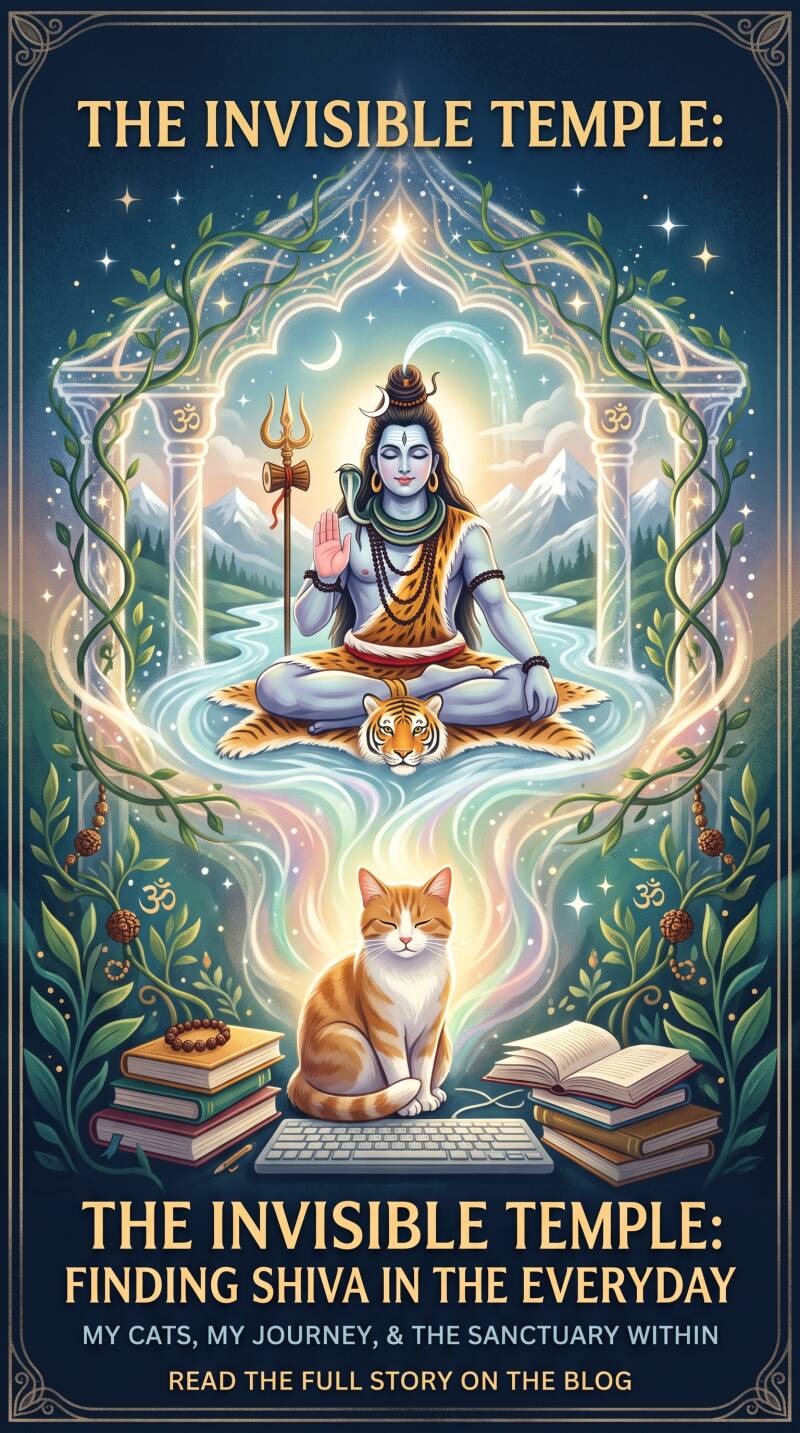
The Invisible Temple: What My Cats, My Struggles, and Shiva Teach Me Every Day
"The heart is the true temple. When there is no stone dome to shelter our prayers, the entire universe becomes our sanctuary."
Introduction: The Silence, the Keyboard, and the Altar
There are mornings when the world feels too vast, too noisy, and yet strangely empty. In the small room where I sit every day to write, there are no temple bells ringing, no scent of sacred incense drifting from an ancient sanctuary, no community of devotees gathered to sing the praises of the Divine. Here, in my geographical reality, temples are absent. The deities of stone and bronze have no official dwellings on our concrete streets.
And yet, my space is deeply inhabited.
On my lap, or curled up in a ball at the foot of my desk, a cat breathes softly. On my screen is this blog, which has become my way of casting bottles into the sea, sharing my doubts, my silent victories, and my aspirations. And in my heart, a presence immense, burning, destructive, and saving all at once: that of Shiva.
How do we connect these three dimensions? How do we build a bridge between the gentle presence of a domestic feline, the daily struggle to become a "good man," and the snow-capped peaks of Mount Kailash where the Lord of Ascetics resides?
This is the mystery of my daily life. It is the liturgy of the ordinary. Through these lines, I invite you to enter my invisible temple. A temple without walls, without priests, but vibrating with a sincere devotion that rescued me from the darkest depths of existence.
Chapter 1: The Wisdom of Felines – My First Meditation Teachers
We often seek spirituality in ancient books, in distant retreats, or from gurus with long beards. We forget that the greatest teachers of wisdom sometimes share our sofa and demand food at fixed hours. My cats are my first spiritual instructors. Every day, they pass down lessons of practical theology without ever uttering a single word.
1. The Art of Pure Presence (Dhyana)
Watch a cat sitting by a window. It does not regret the mouse it missed yesterday; it does not worry about this evening's meal. It simply is. Its concentration on a ray of sunlight, on the rustle of a leaf, or on the flight of a fly is absolute. In Hindu philosophy, this is called Dhyana—deep meditation, the state of absorption where the observer and the observed become one.
My cats teach me to bring my wandering mind back to the present moment. When I worry about the future, when the weight of my past mistakes oppresses me, I watch my cat breathe. Its belly rises and falls in a perfect rhythm of absolute trust in life. It reminds me that the only place where we can touch the divine is here and now.
2. The Dignity of Silence and Sacred Boundaries
The cat is a creature of boundaries. It knows how to say "no" with disarming clarity. If you force your attention upon it, it walks away. It does not seek to please at all costs; it does not compromise its deep nature to gain affection.
For me, as someone striving to become a good man, this attitude is crucial. Being a good person does not mean being a doormat for the world to wipe its feet on. To be good is to possess a quiet dignity. It is knowing how to set respectful but firm boundaries. The cat teaches me self-respect. It shows me that one can love deeply while still preserving one's own inner sacred space.
3. Fluidity in the Face of Obstacles
A cat does not fight against gravity; it plays with it. When it falls, it twists in mid-air with fluid grace to land squarely on its feet. This physical resilience is a beautiful metaphor for spiritual resilience.
Life pushes us, shakes us, and makes us fall from heights that can feel dizzying. The lesson of the cat is to learn flexibility. Do not stiffen under the blow of hardship. Do not let yourself grow rigid with anger or bitterness. Be fluid, adjust your posture mid-flight, and trust your true nature to find its balance once again.
Chapter 2: Becoming a "Good Man" – The Quest for Rectitude
What is a "good man" today? The term can feel almost outdated in a world obsessed with material success, power, appearance, and aggressive self-assertion. Yet, for me, it is the ambition of a lifetime. It is not a matter of glory, but of moral rectitude, active kindness, and inner courage.
THE PATH OF A GOOD MAN │ ┌──────────────────┴──────────────────┐ ▼ ▼ INNER STRENGTH ACTIVE KINDNESS (Endurance, Integrity, (Compassion, Listening, Fidelity to core values) Selfless sharing)
1. Metamorphosis Through Adversity
We are not born a "good man"; we become one. And often, this becoming is forged in the fire of adversity. I have known times of great despair, moments when the ground was pulled from beneath my feet, situations of material, emotional, or psychological distress that could have broken me forever.
In those moments, a choice presents itself: to become cynical and cruel, or to use suffering as a tool to polish the soul. To become a good man is to choose the second path. It is deciding that the wounds we receive will not be used to hurt others, but to better understand their own pain. It is transforming the lead of our misfortunes into the gold of compassion.
2. Integrity in the Unseen
The true character of a man is measured by what he does when he knows no one is watching. Practicing spirituality and kindness when surrounded by a supportive community is relatively easy. But doing it alone, in the isolation of your room, facing your own demons—that is where true heroism lies.
Every day, I try to cultivate this integrity. To be honest in my thoughts, fair in my words, and kind in my smallest, most seemingly insignificant actions. When I feed my cats, when I reply to a comment on this blog, when I refuse to give in to easy gossip or quick anger, I am laying a stone in the foundation of the man I want to become.
Chapter 3: The Shadow and Light of Shiva – The Power of Reconstruction
If my cats are my companions on this path and rectitude is my compass, Shiva is the ocean of energy that allows me to navigate. To many, Shiva is a distant, complex deity, sometimes frightening because of His association with destruction. To me, He is the ultimate savior, the refuge of lost souls, the Lord of transformation.
1. Why Shiva?
In the Hindu pantheon, Shiva holds a unique place. He is not the god of the powerful, the wealthy, or the conformists. He is the patron of yogis, ascetics, outcasts, those who live on the margins of society, or those who carry a deep wound within them. He dwells in the cremation grounds (Smashana), constantly reminding us of the impermanence of matter.
When I was at my lowest, crushed by misfortune, I felt excluded from the world of "happy" and "normal" people. That is where I encountered the energy of Shiva. I realized that my suffering was not a punishment, but an inner cremation ground: a space where my illusions, my false attachments, and my ego had to be reduced to ashes so that the truth of my being could finally emerge.
2. Creative Destruction: The Dance of the Tandava
Destruction, according to Shiva, is never mindless or malicious. It is the indispensable prelude to creation. Just as an old, unsafe house must be demolished to build a sturdy home, the energy of Shiva destroys our destructive mental patterns, our fears, and our toxic attachments to make room for renewal.
-
The Fire of Purification (Tapas): Accepting to feel pain without running away from it, letting it burn away what needs to be destroyed within us.
-
The Ashes of Wisdom (Vibhuti): Wearing our scars not as marks of shame, but as sacred symbols of our survival and our detachment from the trivialities of existence.
Thanks to this perspective, I was able to rise out of my greatest misfortunes. I stopped viewing my trials as personal injustices and integrated them into the great cosmic dance of transformation. I learned to say: "Thank you for this fire that burns me, for it will leave only what is indestructible within me."
Chapter 4: The Temple Without Walls – Practicing Everyday Spirituality
One of the greatest difficulties of my journey is the lack of physical structures around me. There is no Hindu temple in my region, no ashram to retreat to on weekends, no physical community with whom to share my rituals (Satsang). At times, this spiritual solitude is heavy to carry. You feel like a stranger in your own land.
But it is precisely within this constraint that my greatest opportunity for growth lies.
1. The Heart as Garbhagriha (The Holy of Holies)
In a Hindu temple, the most sacred room, the one that houses the main deity, is called the Garbhagriha (literally "the womb chamber"). It is a dark, simple place, stripped of any useless decoration so that attention is focused solely on the divine presence.
Since I do not have an external temple, I had to build this Garbhagriha within myself. My heart has become this dark, quiet room. Every time I close my eyes and take a deep breath, I descend into this secret space. There, I light an invisible lamp. There, I recite the sacred mantra:
$$\text{Om Namah Shivaya}$$
"I bow to the divine Self, to the supreme consciousness that resides within me and in all things."
This mantra does not need bells or priests to vibrate. It resonates in the silence of my own awareness.
┌───────────────────────────────────────────────────────────┐ │ MY DAILY RITUAL WITHOUT A TEMPLE │ ├───────────────────────────────────────────────────────────┤ │ 1. The Silent Awakening: Greeting the energy of life. │ │ 2. Feline Meditation: Sitting quietly with my cats. │ │ 3. Mental Offering: Dedicating my daily tasks. │ │ 4. Sacred Writing: Sharing on my blog. │ └───────────────────────────────────────────────────────────┘
2. The Blog as a Digital Satsang
Spirituality is not meant to be lived in complete isolation. As human beings, we need connection. This is where this blog finds its true meaning.
Having no physical temple where I can meet other seekers of truth, I opened this virtual window to the world. This blog is my Satsang—my gathering for sharing truth. By writing down my doubts, my hopes, my humble understandings of Shiva's wisdom, and the stories of my life with my cats, I weave invisible threads with you who read me, sometimes thousands of miles away.
Every click, every comment, every share is a form of communion. Together, we form a community of souls on the path, a network of hearts helping one another to stand tall in the storm. Practicing here means writing for you. It means offering my reflections like virtual flowers laid at the feet of the Divine within each of you.
Chapter 5: The Unity of All – The Dance of Life
At the end of this reflection, I realize there is no separation between the different aspects of my life. Everything is interconnected in a beautiful, vibrant unity.
┌─────────────────┐ │ SHIVA (Cosmos) │ └────────┬────────┘ │ ┌───────────────┴───────────────┐ ▼ ▼ ┌────────────────────┐ ┌────────────────────┐ │ CATS (Nature) │ ◄──────► │ WRITER (Human) │ └────────────────────┘ └────────────────────┘
When my cat purrs on my lap, it is not a mere mechanical sound. It is a vibration of universal peace, a prayer of pure gratitude toward existence. This purring is, in its own way, a mantra harmonizing with the primordial sound of the universe, the Pranava ($Om$).
When I strive to act with patience, courage, and kindness in my work or social life, I am not just making a moral effort. I am participating in the cosmic harmony (Dharma). I am allowing Shiva's energy of love to manifest through my actions as a man.
And when I go through trials, when sadness knocks at my door, I no longer hide in resentment. I look at my mental altar, turning to the image of Shiva adorned with the crescent moon—the symbol of control over time and the changing cycles of the mind. I remind myself that everything passes, everything transforms, and that every ending is but the beginning of a new dawn.
Conclusion: Let Us Keep Walking Together
To you reading these words on your own screen, perhaps in the solitude of a room, in the noise of a subway car, or in the silence of your own spiritual search: please know that you are not alone.
We do not need temples of stone to touch the sky. We do not need complex rituals to be heard by the Divine. Everything we need is right before our eyes, in our ordinary lives.
-
Learn from nature and from your four-legged companions the simple grace of just being.
-
Fight every day to remain a person of integrity, courage, and gentleness.
-
Trust the transformative forces of the universe—whether they carry the name of Shiva or another flow of life—to guide you out of the shadows.
Thank you for being part of my invisible temple. Thank you for being the pillars of this sanctuary of words and shared journeys. Keep seeking, keep loving, and never forget that the most beautiful divinity already dwells within you.
Har Har Mahadev. May peace be with you, with your homes, and with your faithful companions in life.
Add comment
Comments