


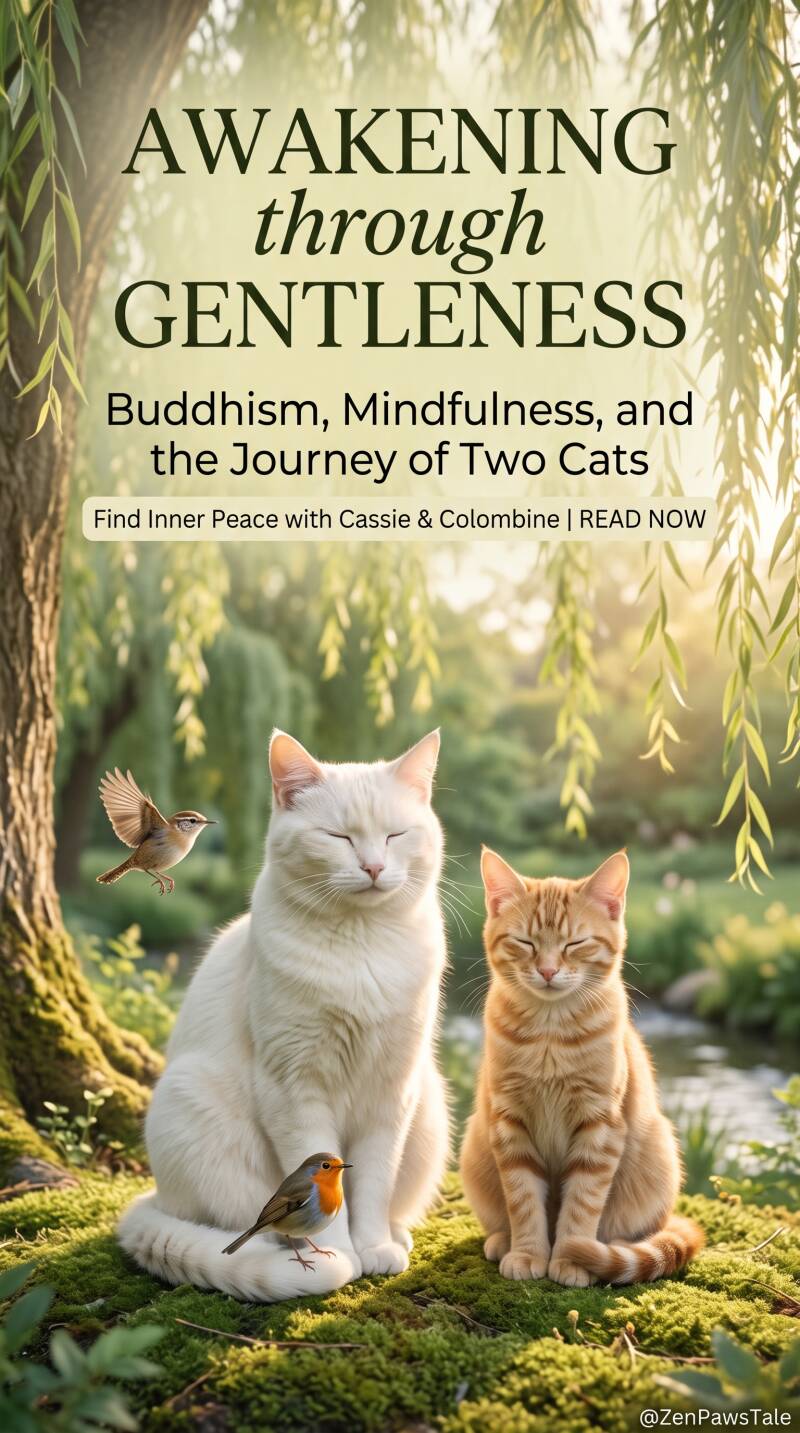
Awakening through Gentleness: Buddhism, Mindfulness, and the Journey of Cassie, Colombine, and the Kitten
“Non-violence is not a passive virtue; it is the active force of universal love.”
In the hustle and bustle of a modern world moving at a frantic pace, the search for inner peace has become an essential quest for many. Buddhism, rich with a tradition spanning over two millennia, offers valuable keys to navigate this chaos. Among these keys are absolute non-violence (Ahimsa) and mindfulness meditation (Sati).
Through the lens of a philosophical tale featuring Cassie, a mature and wise cat who is the embodiment of gentleness, Colombine, a young cat in search of calm, and a tiny observing kitten, we will explore how these ancient concepts apply to daily life. Finally, we will see how this mental clarity can become the engine for extraordinary and peaceful learning in our everyday lives.
Chapter I: The Philosophical Foundations of Buddhism
To understand the story of Cassie and Colombine, it is essential to ground ourselves in the fundamental concepts of Buddhist philosophy.
1. Ahimsa: Universal Non-Violence
In the Buddhist and Hindu traditions, Ahimsa is the supreme rule of conduct. It goes beyond the simple absence of physical violence; it requires active kindness toward all sentient beings. It is the refusal to cause suffering through thought, word, or deed.
-
Non-violence of the mind: Not harboring thoughts of anger or judgment.
-
Non-violence of speech: Communicating with gentleness and kindness.
-
Non-violence of action: Protecting life in all its forms (fauna, flora, humans).
2. Sati: Mindfulness
Mindfulness is the ability to bring one's full attention to the present experience, without judgment. In Buddhism, it is practiced through the four foundations of mindfulness (Satipatthana):
-
Observation of the body and breath (Kaya).
-
Observation of physical and emotional sensations (Vedana).
-
Observation of states of mind (Citta).
-
Observation of the phenomena of reality (Dhamma).
When we meditate, we do not seek to escape reality, but to look at it as it is, developing a quiet clarity.
Chapter II: The Tale of Cassie and Colombine
1. Cassie and Harmony with Nature
At the heart of a valley sheltered from the wind, where rivers sing crystal mantras, lived Cassie. Cassie was not a human, but a small cat with silky fur and a heart so vast that it vibrated at the same rhythm as the Earth. She naturally practiced non-violence to the point that her simple presence transformed the atmosphere around her.
Cassie's gift was unique: she knew how to speak the silent language of birds. To her, a bird was not prey to be hunted, but a messenger of freedom and joy. Every morning, she would sit quietly under an old weeping willow. Chickadees, wild doves, and robins would descend from the canopy to perch very close to her white paws or on her back.
Cassie never frightened them. She spoke to them with soft, melodic meows, whispering words of protection, and offered them signs of affection—gentle little nose kisses that made their feathers rustle. The birds, sensing the absolute absence of fear and predatory instinct in this vegetarian and peaceful cat, would sometimes close their eyes by her side, tasting a safety rare in the wild kingdom.
2. Colombine's Trouble
Not far away lived Colombine. Colombine was a sensitive young cat, but she was often overwhelmed by the noises of the world, her restless young feline thoughts, and the excitement of chasing butterflies. Her mind resembled a monkey swinging from branch to branch, a classic Buddhist metaphor called the "monkey mind" (Kapi Citta).
One afternoon, tired of this constant mental agitation that kept her from finding rest, Colombine visited Cassie. She found her elder surrounded by a cloud of sparrows turned golden by the setting sun, sleeping peacefully among them.
— Cassie, Colombine whispered softly so as not to scare the birds. How do you keep this peace inside you? My mind is like a storm of dead leaves.
Cassie opened her large, calm eyes, stretched her paws gently, flicked her tail to greet a robin that was flying away, and tapped her paw on the green moss carpet beside her, inviting her young friend to sit down.
— Come sit, Colombine, her infinitely wise gaze seemed to say. Peace is not the absence of a storm; it is the calm at the center of it. Let me show you the path of mindfulness.
3. Learning to Breathe
Cassie placed her soft paw on Colombine's paw. The young cat sat up straight beside her, stable, her body aligned and serene like a little fur Buddha.
— Close your eyes, Cassie's benevolent silence whispered. Do not try to chase your thoughts away. Let them pass like clouds in the sky of your mind. Focus solely on the journey of your breath.
The wise cat then began to purr in a very low, steady, and deep tone, guiding Colombine step-by-step through the stages of breath mindfulness meditation (Anapanasati):
-
Inhalation: Feeling the cool air enter the nostrils, go down gently, and inflate the chest. Synchronizing with Cassie's quiet posture.
-
Exhalation: Feeling the warm air go back out, relaxing the shoulders, relaxing the whiskers, letting oneself be cradled by the vibrations of Cassie's purring.
Colombine struggled at first. Her young cat mind wanted to escape, think about a passing insect, get agitated at the slightest noise. But the quiet presence of her elder and her hypnotic purring constantly brought her back to the anchor of the present moment. Gradually, her heartbeat slowed, and a gentle warmth enveloped her.
[ Inhalation: Calm and Anchoring ] │ ▼ [ Present Moment ] ▲ │ [ Exhalation: Releasing Tensions ]
4. The Little Kitten and the Shared Silence
As deep silence settled between the two cats, a tiny ginger kitten with big, curious eyes emerged from the tall grass. He was a being of pure curiosity, usually always in motion, chasing twigs or playing with his shadow.
Attracted by the vibrant stillness of Cassie and Colombine, he stopped a few inches away. The kitten did not understand with words, but he felt the energy of peace radiating from their duo.
He sat down, his paws neatly aligned. He watched Colombine closely, observing the steady rise and fall of her flanks as she learned to meditate. By instinctive mimicry, the kitten half-closed his big golden eyes. He followed the example of the young cat, who in turn followed the example of the wise Cassie. He calmed down, adjusted his breathing, and also began to purr softly, a rhythmic whisper that blended perfectly with Colombine's breathing.
At that precise moment, the separation between living beings and nature faded away. All three shared the same space of pure consciousness. Colombine briefly opened one eye, saw the little kitten meditating beside her, let out a soft purr of contentment, and dived back into the silence, her heart overflowing with gratitude for her four-legged companions.
Chapter III: Learning and Growing with the Zen Mind
Whether it is to remember a school lesson, learn a new language, draw, or memorize complex things, a lack of concentration and stress can sometimes block us. Mindfulness and Zen philosophy offer simple, valuable tools to learn with joy and serenity.
1. The Power of One-Pointed Attention (Ekaggata)
In our world filled with screens and distractions, our brains quickly tire from jumping from one thing to another. Buddhism teaches Ekaggata, which means focus on a single point.
-
In practice: When you study or do an activity, do it 100%. If you read a sentence, be fully present with that sentence. Do not think about what you will do next. Do only one thing at a time, with calm.
2. The Concept of Virya (Joyful Energy)
For learning to be enjoyable and sustainable, effort must never feel like a punishment. Virya is enthusiastic and persistent energy. It is the attitude of a young explorer having fun discovering the world, one step at a time.
-
In practice: Congratulate yourself for every little thing you learned today. Learning is a wonderful journey of discovery, not a speed race.
3. The Zen Method to Memorize Without Stress
Here is how to prepare your mind to study your lessons or easily retain new knowledge:
Step
Zen Technique
Practical Action
1. Anchoring
Prior conscious breathing
Close your eyes and breathe calmly for 3 minutes with Cassie's stillness before starting.
2. Visualization
Kasina (visual meditation)
Close your eyes and mentally project the image, word, or lesson in your head like on a movie screen.
3. Rhythm
Japa (gentle repetition)
Repeat or write what you are learning in a calm and rhythmic way, without rushing.
4. Rest
Mushin (empty mind)
Take a real silent break for a few minutes after finishing to let your brain organize the information.
4. The Secret of the Baby Step
The greatest secret of Zen wisdom is consistency. A tall mountain is not climbed in a single leap, but by taking many quiet little steps. By learning a tiny bit every day, without stress, with Cassie's calm and the kitten's playful curiosity, you can acquire vast knowledge with great ease.
Conclusion: The Chain of Transmission
The story of Cassie and Colombine is a parable about the transmission of harmony. Cassie, the awakened cat, teaches Colombine through her soothing presence and her love for all living things. Colombine, the young cat, by sitting in silence, becomes in turn a role model for the little kitten who observes her and learns from her posture. It is a chain of peace where every living being, big or small, inspires others.
Whether you seek to be friends with the birds, find inner calm, or learn new things, remember that the key lies in the present moment. Inhale, exhale, and trust the path.
Add comment
Comments