

Journey to the Heart of Sophrology: From Indian Roots to Shared Serenity with My Cat
Sophrology is often perceived as a modern relaxation method, a "gymnastics of the consciousness" created in the 1960s. However, to truly understand its essence, we must travel far beyond our Western borders, to the East, and more specifically to India. It is there that this discipline draws much of its spiritual and physical depth. A depth that, surprisingly, finds a perfect echo right in my living room, during my shared sessions with my cat, Cassie.
The Heritage of India: Breath and Consciousness
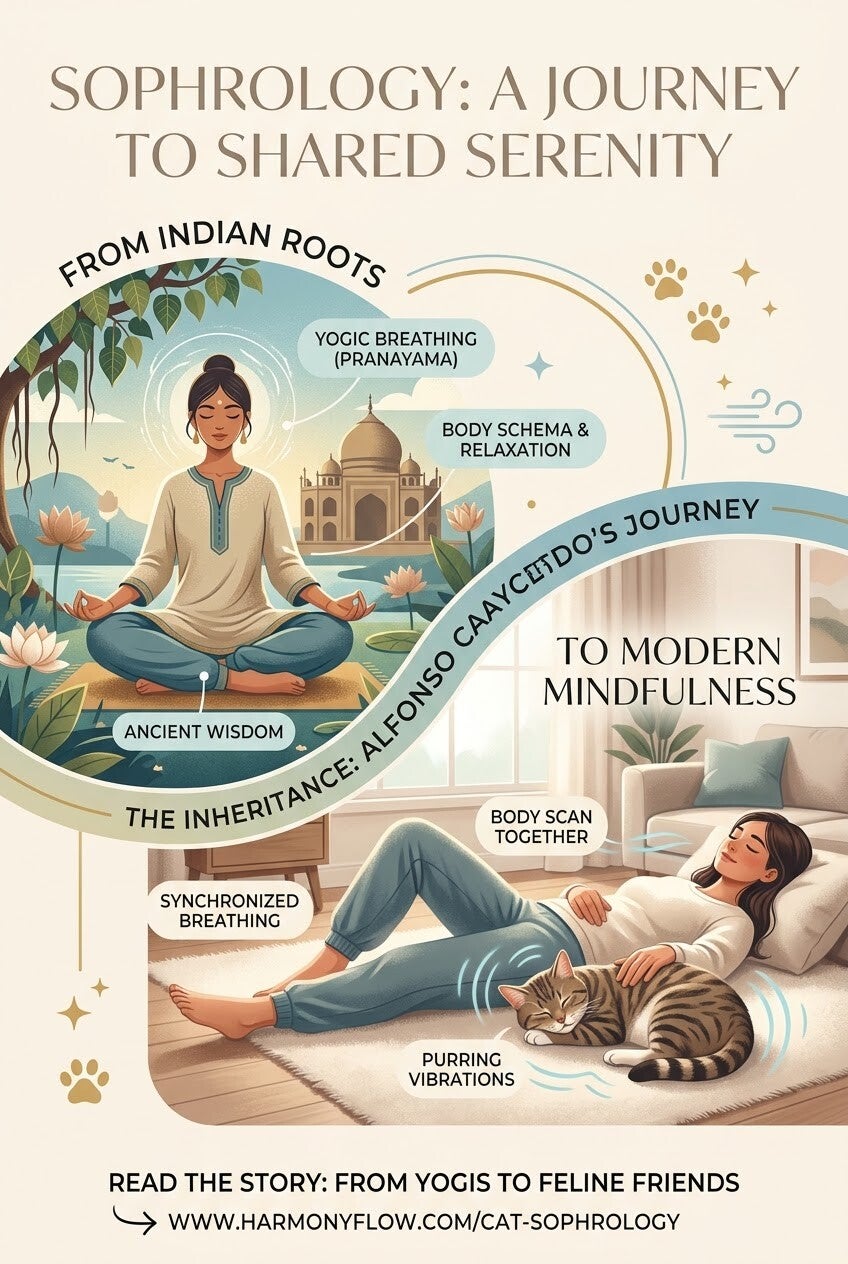
The founder of sophrology, neuropsychiatrist Alfonso Caycedo, undertook a long journey to the East between 1965 and 1968 to enrich his method. In India, he discovered and studied ancestral Yoga, meditation, and altered states of consciousness.
Modern sophrology owes a great deal to this Indian wisdom:
The body schema: Just like in Yoga, sophrology invites us to inhabit our bodies, to feel every tension and every release, without judgment.
Pranayama (breath control): Sophrological breathing exercises are the direct descendants of yogic breathing techniques. India has understood for millennia that the breath is the bridge between the body and the mind.
Eastern phenomenology: Learning to welcome sensations "as if it were the first time," with the wonder and purity of a fresh mind, is directly inspired by Indian meditative postures.
This connection with oneself, inherited from the yogis, creates a soothing energy that radiates beyond our own bodies. And that is exactly what I discovered thanks to an unexpected practice partner.
Cassie: A Four-Legged Sophrology Assistant
Sophrology isn't always practiced in the absolute silence of a professional's office. At my home, it is experienced as a duo with Cassie, my cat. Animals, and particularly felines, are true emotional sponges, highly sensitive to our heart rates and our body language.
The Shared Body Scan
One of the fundamental exercises in sophrology is the "body scan" (or basic sophronization), which involves mentally relaxing every part of the body, from head to toe. Whenever I begin this exercise, Cassie invariably comes to settle down next to me.
At that moment, I gently place my hand on her body. This simple physical contact becomes a powerful anchor. While mentally scanning my own body to release tension, I feel Cassie's warmth under my fingers, the slight twitches of her muscles, and then her total surrender. Her purring, which emits low frequencies known for their therapeutic benefits, synchronizes with my own relaxation. It is an exchange of soothing energies, a perfect resonance.
The Magic of Breathing Techniques
But what is most fascinating about Cassie is her reaction to breathing exercises. She absolutely loves breathing techniques.
When I take a deep breath in through my nose, expanding my belly, and then exhale long and slowly through my mouth (as we do in cardiac coherence or abdominal breathing exercises), Cassie reacts. She half-closes her eyes, her ears relax, and the rhythm of her own breath seems to align with mine.
The vibrations of my deep breathing rock her to sleep. In those moments, she stops moving altogether, fully savoring this moment of pure calm. She seems to intuitively understand the exercise, proving that the language of relaxation and breath is universal.
Conclusion: Universal Harmony
Whether we look at the ancient texts of India or observe the peaceful reaction of a pet, the conclusion is the same: body awareness and breath control are universal keys to well-being.
Practicing sophrology with Cassie is not just an amusing anecdote; it is a true lesson in grounding. She reminds me, in her own feline way, that the harmony sought by Indian sages millennia ago is accessible here and now, right at our fingertips, to the rhythm of a shared breath.
Add comment
Comments