

The Mirror of the Soul: Psychoanalysis, Hindu Philosophy, and the Wisdom of Cats
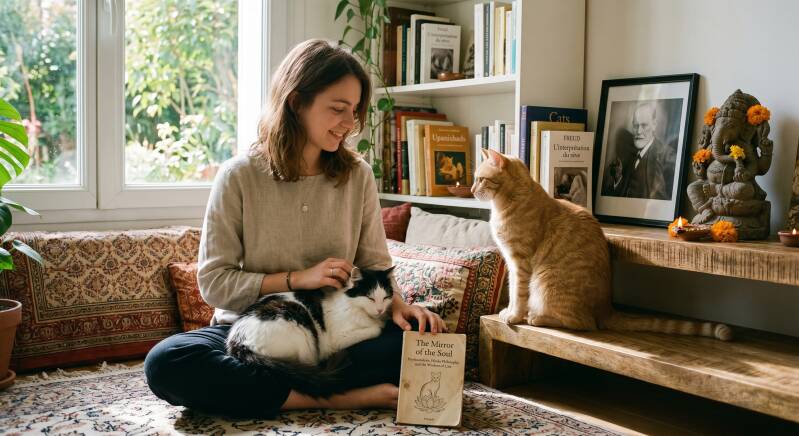
Since childhood, human beings have sought anchors to make sense of their inner world. In this quest, animals, and particularly cats, occupy a unique place. For Colombin, Cassie, and their guardian, this relationship goes far beyond simple domestic attachment: it becomes a deeply therapeutic and spiritual space.
By bridging the perspectives of Western psychoanalysis (led by Sigmund Freud) and Hindu philosophy, we discover that our feline companions do not just share our daily lives; they connect our childhood to the absolute.
1. The Psychoanalytic Perspective: The Cat, Childhood, and the Unconscious
For Sigmund Freud, psychological development begins in early childhood. Children experience phases where the boundary between themselves and the outside world is porous. This is where the cat acts as a powerful psychological mediator.
The Transitional Object and the Mirror of the Self
Although the concept of the "transitional object" was formalized by Donald Winnicott (a successor of Freud), it is directly rooted in childhood psychoanalysis. For a child, a cat like Colombin or Cassie is not just an animal. They are a constant presence, both "other" and an "extension of oneself."
-
The cat does not judge: Unlike parents who impose rules (the Freudian Superego), the cat accepts the child unconditionally.
-
The mirror of projections: Our anxieties, our anger, and our unfulfilled childhood needs for love are projected onto the cat. If Cassie comes to purr during a moment of sadness, she absorbs and validates this emotion without saying a single word.
The Cat as a Figure of the Freudian Id
Freud divided the psyche into three parts: the Id (drives, pure instinct), the Ego (consciousness, reason), and the Superego (morality, rules). The cat is the perfect embodiment of a peaceful and mastered Id. They sleep when they want, hunt by instinct, ask for affection at their own pace, and superbly ignore social conventions. By watching Colombin live his cat life, we unconsciously reconnect with our own childhood: the one before the rules, the one of pure and innocent instinctual freedom.
2. The Dialogue with Hindu Culture and Philosophy
While Freud helps us analyze our mental structures, Hindu philosophy expands this vision by integrating a cosmic and spiritual dimension. Where Freud sees unconscious drives, India sees the play of Illusion ($M\bar{a}y\bar{a}$) and the quest for Unity.
This double nature of the cat invites us to bridge two continents of thought: on one side, Western psychoanalysis, which explores the depths of the personal unconscious, and on the other, Hindu spirituality, which opens up to the universality of the soul. Where Freud seeks to heal the wounds of the Ego, Indian philosophy invites us to transcend it to find primordial unity through our life companions.
From the Freudian Unconscious to the Atman (The Self)
In Hinduism, every living being carries a spark of the divine within, called Atman (the individual soul), which is identical to Brahman (the universal soul).
-
Freud explained that our feeling of isolation comes from the barriers of our Ego.
-
Hindu philosophy (especially Advaita Vedanta, or non-duality) teaches that the separation between humans, animals, and the universe is an illusion ($M\bar{a}y\bar{a}$).
When you look Cassie or Colombin in the eyes, what you feel is not just psychological affection. It is the recognition of the Atman within them. The cat, through its silent presence, helps us transcend our small, suffering "Ego" to touch a broader, shared consciousness.
The Cat as a Master of Vairāgya (Detachment)
Hindu philosophy highly values non-attachment (Vairāgya) and meditation (Dhyāna). The cat is a natural yogi. Watch Colombin in his sphinx-like pose: he is fully present, here and now. He does not anticipate the future (no existential anxiety) and does not regret the past. He embodies the state of Samādhi (deep concentration).
Where a patient on Freud's couch might need to talk for hours to calm their anxiety, simply breathing to the rhythm of Cassie's purring plunges us into an instant state of meditation, aligned with the ancient frequencies of India.
3. Synthesis: Colombin and Cassie, Guides Between Two Worlds
To fully understand your own history, your childhood, and your connection with your cats, it is helpful to bring these two visions into dialogue. Colombin and Cassie reveal themselves to be precious guides, combining the psychological care of the soul with daily spiritual awakening.
Conclusion
Childhood is the moment when we were closest to our wild and divine nature. As we grow up, society imposes masks on us.
Cats like Colombin and Cassie act as silent therapists. On one hand, they reassure our inner child by offering us unconditional love, worthy of the best psychoanalytic cure. On the other hand, they remind us of the wisdom of the Upanishads: we are all interconnected. By taking care of them, we are taking care of our own soul, and of the entire universe.
Add comment
Comments