

The Art of Succeeding Without Losing Yourself: What Hinduism and Buddhism Teach Us About True Wealth
In our modern societies, the definition of success seems to have frozen into a single, relentless mold: accumulation. To succeed, we are told, is to give all of one's time, all of one's energy, and sometimes even sacrifice one's health and relationships for money. We are taught to measure our human worth by the size of our bank account, the prestige of our title, or the brilliance of our material possessions.
Yet, an inner voice persists in whispering: "What good is it to gain the whole world if you end up losing your soul?"
Facing this exhausting race, the ancient wisdoms of Hinduism and Buddhism offer a silent revolution. They invite us to flip our perspective: what if true success was not about having, but about being?
The Great Illusion: When Material Possessions Own Us
Hinduism uses a powerful concept to describe our fascination with the material world: Māyā (illusion). Māyā is not an absence of reality; it is an error of perception. It is believing that lasting happiness can be extracted from external, temporary, and changing objects.
When we give everything for money, we become slaves to what we believe we own. Buddhism deepens this idea through the notion of Samsāra (the cycle of rebirths and suffering) and Dukkha (fundamental unsatisfactoriness). Material desire is like saltwater: the more you drink, the thirstier you get.
External appearances, social roles, and the masks we wear — which are often nothing more than shallow roleplays, much like theatrical characters such as Columbine — lose all importance when faced with the raw truth of our existence. Seeking happiness in these illusions simply makes no sense.
The Lesson of Raw Wood and the Wisdom of the Cat
Once freed from the illusion of material importance, our relationship with the world is spectacularly simplified.
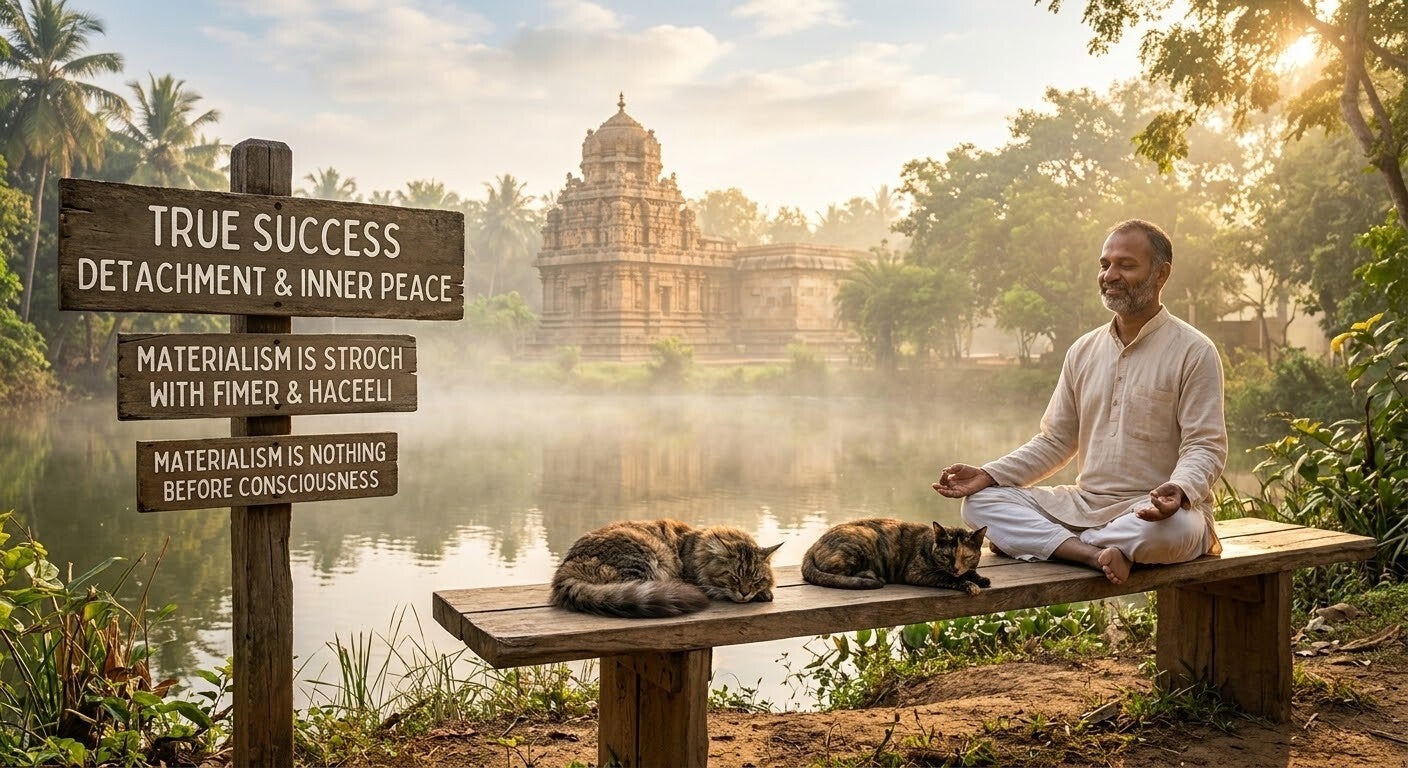
“Sitting on raw wood or lying on a luxury bed, deep down, is the exact same thing.”
This sentence alone summarizes the freedom of the awakened mind. For someone who has found peace within, external physical comfort is no longer a condition for happiness. Whether the seat is hard or soft, the quality of presence and awareness remains unchanged. Luxury adds nothing to the value of the present moment, and discomfort takes nothing away from it.
We can find a wonderful illustration of this truth in the animals that share our lives. Look at cats. A cat doesn't care about the price of its bed or the brand of its toys. It can completely ignore an expensive silk cushion to sleep with absolute bliss in a simple cardboard box or on a piece of wood in the sun. Cats live in the immediacy of being. They do not calculate their value based on their possessions. They remind us, through their simple presence, that material comfort is nothing compared to peace of mind and the pure joy of existing.
The Battle to Be Conscious
Choosing not to give everything to the material is not an easy path. On the contrary, it is a genuine daily battle.
In a world saturated with advertisements, social media, and performance demands, deciding to slow down and stay conscious requires immense courage. It is swimming against the current. Being conscious means observing oneself, recognizing one's attachments, and deliberately choosing simplicity over the intoxication of consumption.
This battle for consciousness is the beating heart of the spiritual path. It is the transition from being a "social sleepwalker" (someone who chases money just because everyone else is doing it) to an awakened being (someone who chooses their own values).
It is Better to Be Poor and Serene Than Rich and Miserable
Eastern spirituality does not condemn wealth itself, but rather the attachment to it. Hinduism recognizes four legitimate goals in life (Purusharthas), among which is Artha (material prosperity). However, Artha must always be aligned with Dharma (moral duty, justice, righteousness) and ultimately lead toward Moksha (spiritual liberation).
If material wealth is obtained at the expense of inner peace, compassion, and ethics, it becomes a golden cage. This is why the popular wisdom of these traditions reminds us that it is infinitely better to live modestly with peace of mind than to live rich but consumed by anxiety, fear of loss, anger, or loneliness. A spiritual proverb reminds us: "Outer poverty is nothing if the mind is crowned with wisdom; but the inner poverty of a rich person is an endless tragedy."
So, What Does It Mean to Succeed in Life According to Buddhism and Hinduism?
In the light of these teachings, succeeding in life radically changes its definition:
-
Success is awakening to your true nature: In Hinduism, it is realizing that our individual soul (Atman) is part of a universal whole (Brahman). In Buddhism, it is realizing the emptiness of the ego and reaching a state of lasting peace, Nirvana.
-
Success is cultivating detachment: It is being able to possess things without letting those things possess us. It is being able to appreciate a comfortable bed, but being just as happy sitting on raw wood.
-
Success is living in the present moment: It is finding the simplicity of existing, without being haunted by regrets of the past or anxiety for the future.
-
Success is acting with compassion: Success is measured by the amount of suffering we manage to relieve around us, not by the amount of wealth we manage to hoard.
True success is not a summit to reach at the cost of your soul. It is a homecoming, a return to simplicity, kindness, and a peaceful conscience. By choosing this path, you do not lose the world; you finally reclaim yourself.
Add comment
Comments