 Skip to main content


The Enigma of the Velvet Gaze: Legends, Mysteries, and the Spirituality of Cats
Since the dawn of time, a silent silhouette has slipped along the borders of our perception. It crosses civilizations without ever allowing itself to be fully tamed, retaining a share of shadow that neither science nor domestic life has managed to dispel. The cat.
Who is this being who shares our daily lives while seemingly constantly observing a world we cannot see? Is it a simple household companion, or the millennial guardian of invisible portals? From sacred India to the sands of Egypt, from Scandinavian forests to Zen temples, the cat has never ceased to intrigue mystics, poets, and sages.
Let us dive into the secrets of an animal that, beneath its velvet appearance, conceals one of the greatest spiritual mysteries of our Earth.
Chapter 1: The Cat in Sacred India – Gentleness, Protection, and Spiritual Surrender
To understand the true spiritual dimension of the cat, we must turn to one of the oldest and richest spiritual traditions of humanity: Hinduism. Far from the sometimes ambivalent image that the medieval West projected onto it, Hindu thought approaches the cat through the prism of compassion (Ahimsa), divine symbolism, and a theological metaphor of striking beauty.
Shasthi Devi and the black cat: Protectors of life and childhood
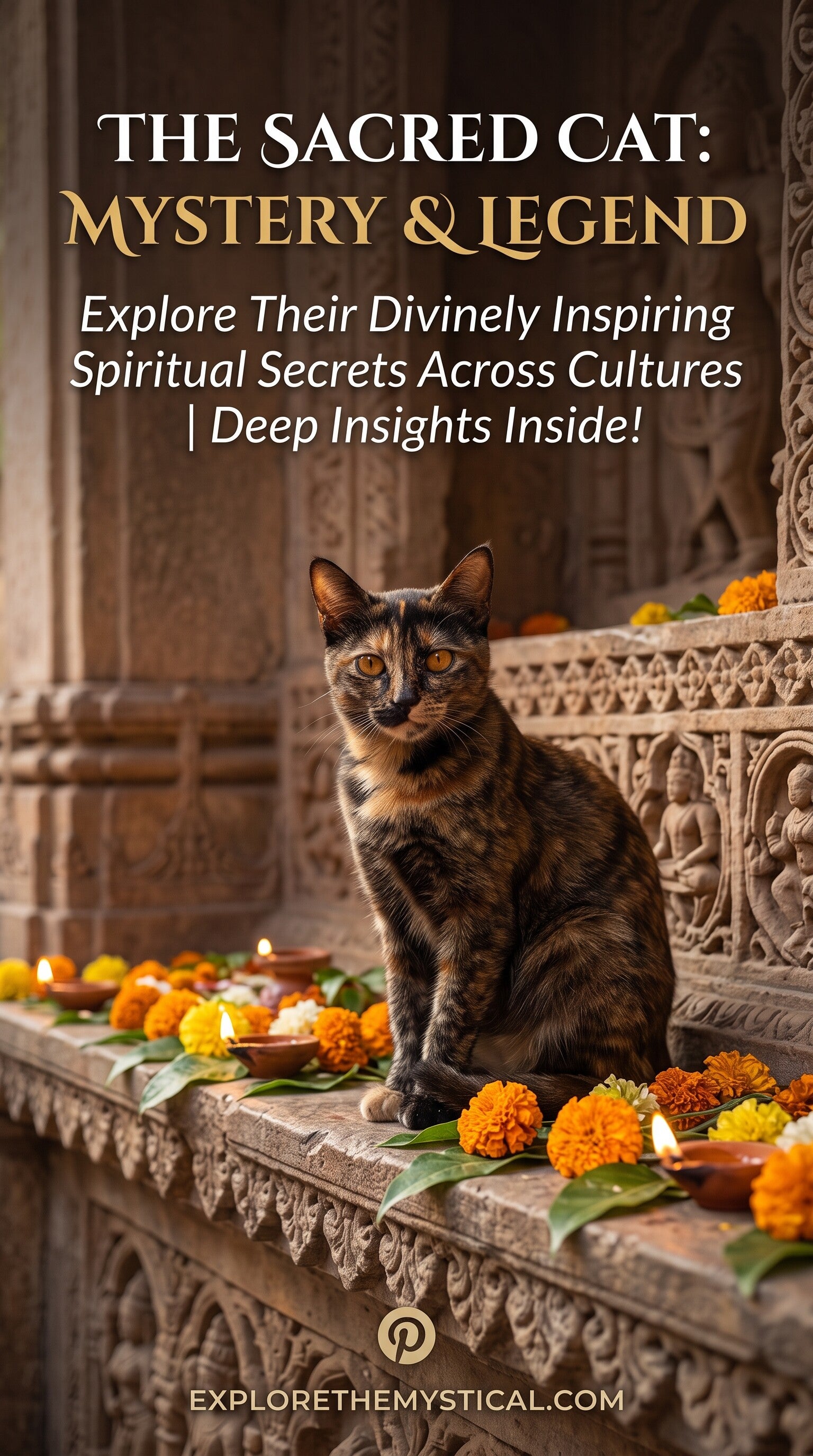
In the rich tapestry of Hindu mythology, deities are often associated with a Vahana (a vehicle or animal mount) that embodies and manifests their powers on the earthly plane. For the goddess Shasthi (or Shasthi Devi), this sacred mount is none other than a cat, often depicted as a black or tabby cat.
Shasthi Devi is the great protector of children, motherhood, and fertility. Invoked to grant healthy offspring and to watch over newborns against diseases and invisible dangers, she is deeply revered in many regions of India, particularly in Bengal.
The choice of the cat as Shasthi's Vahana is far from accidental:
-
The ultimate maternal instinct: The mother cat is renowned for the unwavering attention, gentleness, and vigilance she shows toward her litter. She moves her kittens with infinite delicacy while remaining ready to face the largest predators to defend them.
-
The destruction of pests: In an agricultural society, the cat protects harvests from rodents, thereby preventing the spread of diseases and famine, and preserving the lives of the village children.
Offending or harming a cat is considered, in this tradition, as a direct affront to Shasthi Devi herself, likely to bring misfortune to the home and descendants. Conversely, feeding and caring for passing cats is a simple act of devotion that attracts the goddess's blessings upon the family.
[Icon of Shasthi Devi on her protective cat] /\_/\ ( o.o ) > ^ < Protector of newborns
Marjara-Nyaya: The Theology of the "Way of the Kitten"
One of the deepest contributions of Hinduism to mystical philosophy using the image of the cat lies in the theological school of Sri Vaishnavism (specifically the Tenkalai branch or Southern school). To explain the relationship between the human soul (Jivatma) and divine Grace (Prasada), sages developed two great metaphors: the way of the monkey (Markata-Nyaya) and the way of the cat (Marjara-Nyaya).
-
The Way of the Monkey (Markata-Nyaya): To survive, the baby monkey must actively cling to its mother's fur as she leaps from branch to branch. If it lets go out of fatigue or weakness, it falls. This way symbolizes a spiritual path based on personal effort, asceticism, rituals, and human will. The aspirant must make constant efforts to "hold on" to God.
-
The Way of the Cat (Marjara-Nyaya): The kitten, on the other hand, makes no physical effort to hold onto its mother. It surrenders completely. It is the mother cat who gently grasps it by the scruff of the neck with her teeth to carry it to safety. The kitten remains passive, trusting, and relaxed. This metaphor illustrates the doctrine of Prapatti (total and trusting surrender to the divine will). The soul realizes its own limitations and chooses to rely entirely on the Grace of God. It is a spirituality of pure love, absolute trust, and letting go. The devotee no longer has to fear the storms of the external world, knowing that the "Divine Mother" carries them at every moment over the chasms of existence.
Respect for life (Ahimsa) and feline karma
In the philosophy of Sanatana Dharma (Hinduism), the principle of Ahimsa (non-violence toward all living beings) is cardinal. Every animal carries within it a spark of the Eternal (Atman). Sacred texts, such as the Puranas, frequently remind us that cruelty to animals generates particularly heavy karma.
The cat, by its independent and sometimes vulnerable nature, tests our ability to offer selfless compassion. Unlike the dog, traditionally praised for its loyalty and immediate utility, the cat does not seek to please. To love and feed it is to practice unconditional love that expects nothing in return – a form of Karma Yoga (the yoga of selfless action) in everyday life.
Chapter 2: Guardians of the Threshold – Ancient Egypt and the Cult of the Invisible
If India saw in the cat a metaphor for spiritual trust, ancient Egypt elevated it to the status of a national deity, perceiving in it a direct bridge between the world of the living and that of the dead.
|\_/\| | o.o| <- Bastet, solar and nocturnal vigilance \_ _/ / \ /| |\
Bastet and Sekhmet: The two faces of feline power
In the Egyptian pantheon, the feline embodies cosmic duality par excellence: protective gentleness and destructive fury.
-
Sekhmet, the lioness: She is the destructive heat of the sun, war, but also medicine and healing. She represents the raw force that purifies and destroys evil to restore cosmic order (Ma'at).
-
Bastet, the cat: She is the transition from the lioness to a softened, domesticated, and benevolent form. Goddess of the home, motherhood, music, and joy, Bastet protects households from evil spirits, diseases, and the dark forces of the night.
The Egyptians noticed that cats' eyes dilate and glow in the dark, as if they trapped the rays of the setting sun to illuminate the night. For this reason, the cat was considered a valuable ally for crossing darkness – whether physical or spiritual.
The sentinelles of the astral world
For Egyptian initiates, the cat did not just hunt mice; it filtered invisible energies. It was believed that cats spent a large portion of their sleep time traveling in the astral planes, purifying the etheric atmosphere of the house from psychic residues left by anger, sadness, or wandering entities.
Killing a cat, even accidentally, was punishable by death. Upon the passing of a family cat, household members would shave their eyebrows as a sign of deep mourning, and the animal was mummified with the same honors and precious perfumes as a high priest, so that it could continue its role as a guide and protector in the afterlife (Aaru).
Chapter 3: Sons of Ether – Buddhism, Zen, and Far Eastern Wisdom
As we cross Asia, the presence of the cat continues to inspire philosophers and meditators. Although some ancient Buddhist texts sometimes show suspicion toward the animal's independence, the reality of the temples tells a completely different story.
The cat as a Zen meditation master
For monks in Zen monasteries in Japan and China, the cat is often considered, not without humor, as an "accomplished old master" who has already achieved enlightenment without needing to read a single sutra.
Watch a cat sleeping or observing a fly:
-
Total presence: It is neither in the regret of the past nor in the anxiety of the future. It is the very embodiment of the Here and Now.
-
Energy conservation: It knows how to alternate between absolute relaxation (the body completely fluid and relaxed) and lightning-fast reactivity in a fraction of a second. This is the very essence of the warrior's and meditator's mind: a deep calm supported by unwavering vigilance.
-
Non-attachment: The cat approaches when it decides, leaves without explanation, and does not seek to validate its ego through the gaze of others. It teaches inner freedom.
A famous Zen story tells of a monastery that was home to a cat that always sat among the monks during evening meditation. Far from disturbing them, its silent presence and regular breathing stabilized the energy of the group, acting as a vibrational anchor for novices seeking inner calm.
The Maneki-Neko and the legend of Gotoku-ji Temple
In the 17th century, in Japan, a poor priest lived in the small Gotoku-ji temple in Tokyo with his cat named Tama. Despite his poverty, the priest always shared his meager food with his companion.
One day, a wealthy lord and samurai, caught in a violent storm, took shelter under a large tree near the temple. Looking up, he saw a cat sitting near the temple door, seemingly inviting him to approach by raising a paw. Intrigued by this unusual gesture, the lord left the tree to join the animal. Moments later, lightning struck the tree directly, pulverizing it.
Grateful to have his life saved by the cat's mystical warning, the lord became the temple's patron, bringing it prosperity and ensuring a peaceful life for the priest and Tama. From this legend was born the Maneki-Neko, the famous lucky cat that invites fortune and spiritual protection into Asian homes and businesses.
Chapter 4: From Shadow to Light – The Tribulations of the Cat in the West
The Western history of the cat is a true spiritual dark novel, passing from pagan veneration to diabolical persecution, before a modern rehabilitation under the banner of esotericism and therapy.
* * * * * * * * * * * /\___/\ * <- Companion of the goddess Freya * ( =^= ) * * and guardian of nocturnal secrets * ( ) * * * \_|_/_/ * * * *
Freya's chariot and Nordic nature spirits
In Norse mythology, the cat is closely linked to Freya, the goddess of love, beauty, fertility, but also of practical magic (Seidr) and divination. Freya's celestial chariot is pulled by two giant, blue or gray cats, named Bygul (bee of gold / honey) and Trjegul (tree of gold / amber).
These cats were not mere beasts of burden; they were her eyes and ears in the nine worlds of Yggdrasil. They represented the ability to move silently through dimensions and to perceive the magical currents of the earth. Norse farmers often left offerings of milk in their fields to secure the favors of Freya's cats, ensuring good harvests and the protection of births.
The great medieval misunderstanding: The hunt for the ally
In the Middle Ages, the Christian West undertook to root out old pagan beliefs. The intimate link between the cat and the magical practices of wise women (herbalists and healers, labeled "witches") would prove fatal to the animal.
In 1233, Pope Gregory IX issued the bull Vox in Rama, which for the first time associated the black cat with satanic cults. This was followed by a tragic period of obscurantism in which millions of cats were persecuted, burned, or drowned.
This collective madness had devastating material consequences: the eradication of cats caused an exponential proliferation of rats, the primary vectors of the flea that carried the Black Plague, which decimated a third of the European population in the 14th century. A painful karmic lesson that cruelly reminded humanity of the importance of preserving the natural balance of creation.
Chapter 5: The Feline Sixth Sense – Where Science and Mysticism Agree
How can we explain why the cat always seems to capture realities invisible to our eyes? Where the mystic speaks of aura and vibrational planes, modern science is beginning to put fascinating words to the extraordinary physiological capacities of the feline.
Sensory Capacity
Physical Perception (Science)
Spiritual / Esoteric Interpretation
Night Vision
Captures ultraviolet light, tapetum lucidum multiplying light.
Ability to see etheric energy and nocturnal astral entities.
Whiskers (Vibrissae)
Detect tiny variations in air pressure.
Extreme sensitivity to energetic disturbances and the intentions of others.
Supersonic Hearing
Perceives frequencies up to 64,000 Hz (well beyond human hearing).
Reception of subtle vibrations and whispers from invisible worlds.
Purring
Emitted between 20 and 140 Hz, promotes tissue and bone regeneration.
Sacred healing frequency, harmonization of human chakras.
Vision of invisible dimensions
Have you ever seen your cat stare intensely at an empty corner of a wall, its pupils dilated, sometimes emitting a light meow or following an invisible movement with its gaze?
In esoteric traditions, it is explained that the cat's visual spectrum extends far beyond the light visible to humans. It is capable of perceiving the electromagnetic field of living beings (the aura) as well as thought-forms or passing entities. The cat does not worry about these presences; it observes them, evaluates their vibrational level, and acts as a filter for negative waves. If an energy displeases it, it will move away or adopt a defensive posture, acting as a true "spiritual pollution detector" in the home.
Purring: A sacred healing wave
Science has shown that a cat's purr is not just an expression of well-being, but also a mechanism for self-healing and regeneration. The vibrations emitted by the cat when purring have specific frequencies (around 25 to 50 Hz) used in physiotherapy to accelerate bone consolidation, relieve pain, and repair muscles.
On the spiritual plane, this vibration acts as a silent mantra. It relaxes the nervous system of the human caressing the cat, slows the heart rate, and promotes a state of alpha brain waves (conducive to meditation and peace of mind). The cat then behaves as a natural vibrational therapist, offering its own harmonizing energy to those around it.
Chapter 6: The Cat as a Spiritual Guide and Power Animal
For those who share their lives with a feline, the relationship often goes beyond that of a simple owner to their pet. It is a true covenant of soul to soul.
* . * . * . * /\___/\ "The cat is the mirror ( =o_o= ) of our inner state." \ Y / / \ . * . * .
The mirror of our inner state
The cat is an animal of absolute psychic sensitivity. Unlike dogs who often try to comfort their master by fussing or begging for attention, the cat reacts as an uncompromising mirror of our own inner weather:
-
If you are agitated, anxious, or angry, your cat will show itself to be elusive, nervous, or distant.
-
If you manage to calm down, meditate, and align your energies, it will naturally come and settle near you, attracted by the clarity of your vibration.
It thus teaches us the importance of self-control and emotional authenticity. One cannot lie to a cat; it does not react to our words, but to the energy we emit.
The different colors of cats and their energetic vibrations
In popular and esoteric beliefs, the cat's coat influences the type of energy it most readily channels:
-
The Black Cat: Contrary to unfair superstitions, the black cat is the ultimate spiritual protector. It absorbs and transmutes the heaviest negative energies, protects against jealousy, and brings occult wisdom. It is the guardian of the house against the evil eye.
-
The White Cat: Linked to lunar energy, purity, and spiritual clarity. It promotes intuition, prophetic dreams, and brings a vibration of peace, calm, and emotional healing into the home.
-
The Ginger Cat (or Orange Tabby): Channels solar energy, vitality, courage, and abundance. It stimulates the creativity of its guardians and brings an atmosphere of joy and dynamism.
-
The Tricolor Cat (Calico or Tortoiseshell): Considered in many cultures (notably in Japan and Ireland) as an absolute lucky charm. It combines the forces of earth, fire, and water, protecting the family from poverty and accidents.
-
The Grey Cat: Embodies sacred neutrality, stability, and peace of mind. It helps one navigate transition periods with grace and wisdom.
Conclusion: The Eternal Companion of Mysteries
The cat remains a being apart, a walker of the invisible placing its velvet paws on the unstable ground of our material reality.
Whether it is Shasthi Devi's companion teaching us the sacred way of trusting surrender (Marjara-Nyaya), Bastet's solar sentinel in ancient Egypt, or the old Zen master dozing on our doorstep, it reminds us at every moment that there are far more things in the universe than our human eyes can perceive.
The next time you cross paths with a cat's gaze, do not consider it simply as an animal. Greet in it the guardian of millennial mysteries, the silent ally of your soul, and let yourself be carried away, if only for a moment, by the tranquil wisdom of its purr.
Om Shasthi Devyei Namaha — Homage to the goddess Shasthi and to her benevolent feline messengers, who watch over the life and peace of households.
Add comment
Comments