

The Breath of the Earth: The Harmony of the Sacred Basin
The Sanctuary of the Dawn
In the verdant folds of Madhya Pradesh, where the Vindhya hills greet the sky, stands the sanctuary of Devagiri. This place belongs to no man, but to life itself. Here, the ruins of an ancient Hindu temple dedicated to Shiva, carved with mossy bas-reliefs, share their shadow with an ancient rock-cut Buddhist monastery. For centuries, the bronze bells of the temple have answered the deep gongs of the meditation hall, creating a symphony of peace that envelops the sacred forest.
In this valley, nature unfolds its colors with a sacred generosity. Wild jackfruit trees and century-old banyans stretch their branches like protective arms. This is the realm of Ahimsa, absolute non-violence, and Karuna, universal compassion. Here, every heartbeat, whether it beats beneath the coat of a leopard or under the saffron robe of a monk, is recognized as a spark of the divine.
The Guardians of the Forest
At the center of this harmony live beings of great nobility.
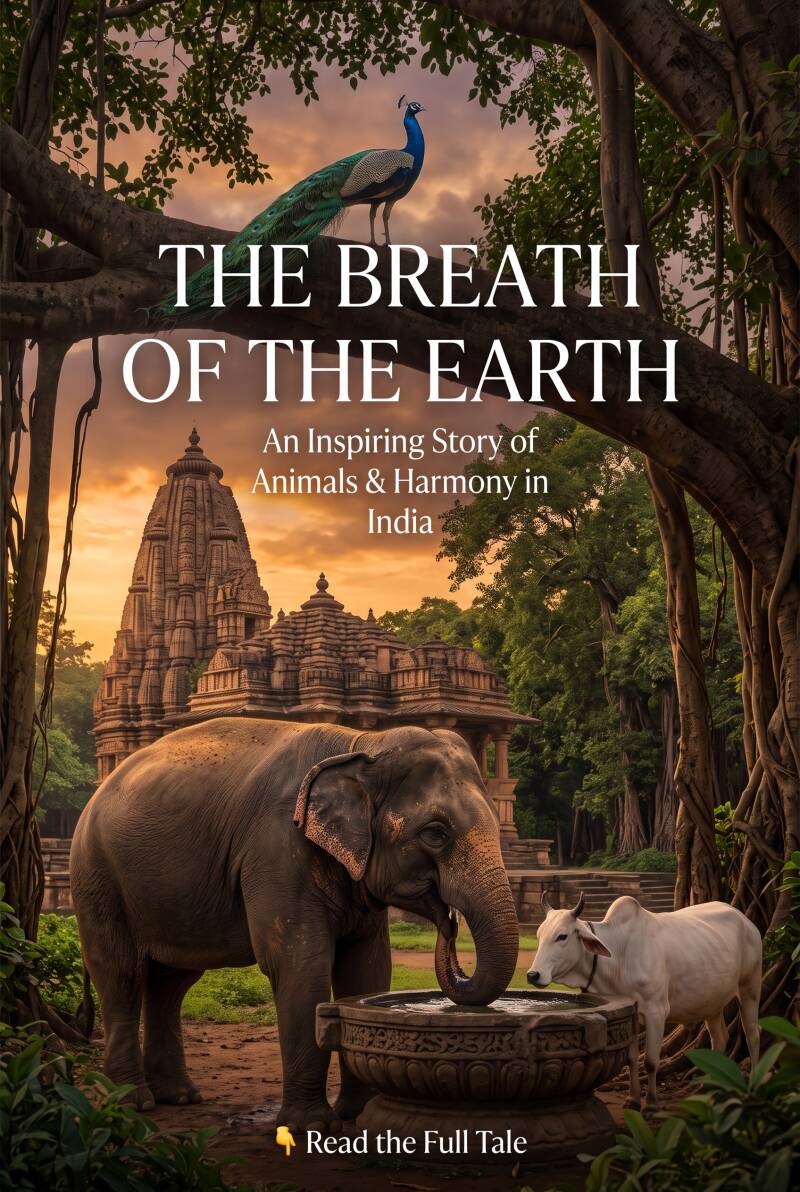
First, there is Gajendra, an elephant of impressive stature. His tusks, polished by time, bear the marks of decades spent roaming these forests. Gajendra is the guardian of the valley's memory. His gait is slow, royal, and infinitely careful; he watches closely never to crush nests hidden in the tall grass. For the villagers of Anandapura, situated at the bottom of the hill, Gajendra is the living manifestation of Ganesha, the remover of obstacles. When he approaches the edge of the village, children bow respectfully, and mothers lay offerings of bananas and coconuts at his feet. The elephant accepts these gifts with a gentle swing of his trunk, a silent gesture of blessing.
Higher up, on the warm stone slabs of the temple, resides Mayura, a majestic peacock with metallic blue and emerald green plumage. Mayura is not simply a beautiful bird; he is the sentinel of the sky. His piercing cries, like trumpet calls, announce changes in the weather, the passage of nocturnal predators, and the awakening of the forest. Buddhist monks see him as a symbol of transformation: just as the peacock is reputed in ancient legends to transmute poisons into brilliant colors, the awakened mind transforms suffering into wisdom.
Near them, Kapi, a young macaque with a bright and witty gaze, is always active. Unlike the turbulent monkeys of the cities, Kapi grew up in the quiet of the monastery. He learned to observe humans in silence. Curious and agile, he spends his days gathering fallen frangipani flowers to place at the feet of Buddha statues, or watching ants lined up on the dirt paths, carefully avoiding disrupting their laborious march.
The Trial of the Dry Land
That year, the month of May brought unprecedented heat. The hot Loo winds swept across the plain, turning rivers into ribbons of cracked dust. Teak leaves turned yellow and fell, depriving the wildlife of their benevolent shade.
The drought set in, threatening. The great river that usually fed the valley had retreated beyond the hills. In the village of Anandapura, the wells were starting to run dry. In the sacred forest, tension was palpable but silent. Natural springs were dying out one by one.
The only water source still active was the Kalyani, the great sacred stone basin located at the crossroads of the temple and the monastery. Fed by a deep underground spring, its level was nevertheless dropping day by day under the effect of evaporation and increasing demand.
It was then that the essential question arose: how to share this declining resource without fear and selfishness breaking the ancient harmony?
The Covenant of Compassion
One morning, as the heat haze was already rising from the ground, Ajahn Sumedho, the elder of the Buddhist monks, and Pandit Shastri, the priest of the Shiva temple, met on the stone steps of the sacred basin.
They did not speak at first. They first looked at the landscape. On the opposite bank of the basin, Gajendra, the elephant, stood motionless under a banyan tree, slowly flapping his ears to cool down. Beside him, a sacred cow from the village, gentle and white, named Surabhi, waited patiently for her turn to drink. Kapi, the macaque, was sitting on a low branch, his usual liveliness tempered by the solemnity of the moment.
"All sentient beings share the same thirst," whispered Ajahn Sumedho, adjusting his saffron robe. "In the Jataka tales of the Buddha's past lives, we learn that the Bodhisattva incarnated many times in animal form—as an elephant, a monkey, a deer—to teach compassion. Today, these animals are our teachers. Look at them. They do not attack, they do not hoard. They wait."
Pandit Shastri nodded, joining his hands in respect. "In truth, every creature carries the Atman, the divine spark, within. To harm one of them, or to deny them the water of life, would be equivalent to desecrating the temple itself. Ahimsa Paramo Dharma: non-violence and universal love are the supreme duties. We must open the gates of the basin to everyone, without distinction."
Together, the monks, priests, and villagers made a decision. Instead of restricting access to the stone basin to preserve their own reserves, they decided to build channels and wide terracotta troughs all around the sacred reservoir. Every morning and evening, the humans would draw water from the deep well to fill these troughs, ensuring that even the smallest animals—birds, squirrels, and rodents—could drink without danger of drowning or being trampled.
The Miracle of Sharing
The plan was put into action the very next day. Villagers brought large clay pots. Kapi, intrigued by the bustle, came down from his tree. Understanding the humans' intention, the little monkey began to clear dry leaves and twigs that blocked the stone channels leading to the outer troughs. His help, though modest, brought smiles of gratitude to the tired faces of the workers.
Gajendra approached slowly. His imposing presence could have caused fear, but the elephant showed extraordinary gentleness. He waited for the village children to finish filling the large stone trough reserved for him. Then, with a fluid motion, he dipped his trunk into the cool water. But instead of drinking everything, he drew only what he needed, then stepped aside to make room for Surabhi, the white cow, and a herd of timid deer that had ventured out of the forest under the elephant's protection.
Suddenly, a shrill cry echoed through the azure sky. Mayura, the peacock, had perched on the temple dome. He fanned his tail, displaying a spectacular array of shimmering feathers, celebrating in his own way this victory of life and unity.
For the next three weeks, the Devagiri basin became an altar of living peace. No angry cry disturbed the warm air. Predators and prey drank just yards apart, united by an invisible truce dictated by mutual respect and the abundance of love poured out by the humans. The monks chanted the Metta Sutta, the discourse on loving-kindness, daily, while the temple bells rang to honor the sacredness of this effort collective.
The Return of the Rain
One evening in June, as the sun was setting in an orange and purple glow, the air suddenly grew heavy. The scent of dry earth intensified. Mayura let out a vibrant call, longer and louder than usual, followed by Kapi's excited cries as he leaped from branch to branch.
Gajendra raised his trunk to the sky and let out a powerful trumpet call that made the valley air vibrate.
A few minutes later, the first drops of the monsoon, heavy and warm, began to hit the dusty stone slabs. A shout of joy rose from the village and the monastery. Torrents of blessed water from the sky filled the dried-up rivers, turned the hills green again, and quenched the thirsty earth.
The trial was over. But in the heart of everyone—monk, priest, villager, elephant, monkey, or bird—remained etched the certainty that the survival and beauty of this world rest on an indestructible golden thread: compassion for everything that breathes, and the certainty that we are all one with the web of life.
Add comment
Comments