

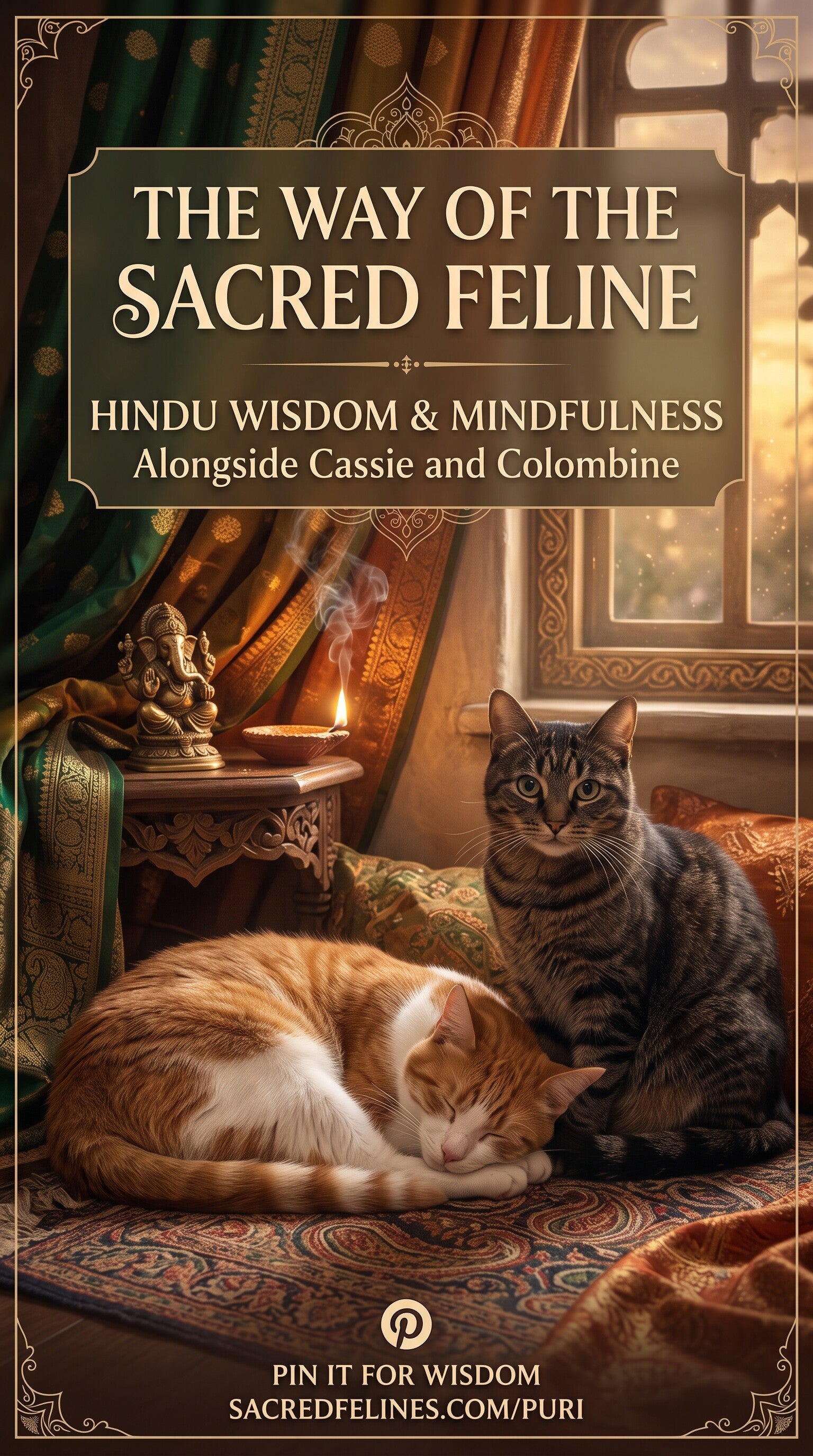
The Way of the Sacred Feline
Metaphysical meditations on Cassie and Colombine in the light of Hindu wisdom
"The cat does not seek the divine. It exhales it."
Introduction: The Temple of Daily Silence
In the gentle twilight of a suspended afternoon, the living room is no longer just a room furnished with wood and carpets; it becomes, through the sole presence of two small beings of silk and mystery, a sanctuary where time no longer flows. Here, Cassie sleeps, curled up on herself like a crescent of red and white moon, while Colombine, motionless on the windowsill, gazes at an invisible point in the void with an intensity that borders on ecstasy.
To the hurried observer, these are but the ordinary occupations of two domestic felines. But for the mind that consents to slow down, for the heart that opens to the subtle resonances of the philosophy of ancient India, Cassie and Colombine cease to be mere pets to become what they truly are: silent gurus, givers of a primordial wisdom.
Hinduism, in its dizzying richness, has never drawn a hermetic border between the human, the animal, and the divine. Everything flows, everything interpenetrates in the great cosmic dance of Lila. By observing these two cats, by letting ourselves be taught by the fluidity of their movements and the depth of their silences, we discover a living, embodied, and warm illustration of India's most sacred texts, from the Upanishads to the Bhagavad-Gita.
This treaty is an invitation to cross the threshold of this domestic temple, to follow the soft steps of Cassie and Colombine on the path of awakening, and to contemplate, beneath the velvet of their fur, the reflections of the Absolute.
Chapter I: The Atman beneath the Silk – The Gaze that Contemplates the Eternal
In the non-dual traditions of India, and particularly in the teachings of Advaita Vedanta, the ultimate truth lies in a disarmingly simple formula: Tat Tvam Asi ("That Thou Art"). This sentence asserts that the Atman, the individual soul, the divine spark nestled deep within every being, is identical to the Brahman, the ultimate and impersonal reality of the universe. The illusion of separation (Maya) is the sole source of our suffering.
To contemplate Colombine when she stops dead in the middle of a room, her gaze magnetically drawn to a point in space that our human eyes cannot perceive, is to witness a physical demonstration of this truth. What does she see? A speck of dust dancing in a sunbeam, or the invisible vibration of the very fabric of reality? Colombine does not look to possess, nor to analyze. Her gaze is pure Sakshi — the silent Witness. She is not separate from what she contemplates. In her perfect stillness, the subject and the object merge. She is the sunbeam, she is the dust, she is the space that contains them.
Cassie, for her part, carries in her eyes an amber clarity that seems to have traversed eons of silence. When she gazes at us, there is in her no judgment, no expectation, no psychological projection. Human beings spend their lives constructing an Ahamkara (the ego, the "I-maker") through titles, possessions, and wounded inner narratives. Cassie, by her mere presence, dissolves this illusion. Before her, we are stripped of our masks. Her gaze reminds us of our own Atman, that inviolable zone of peace that resides within us, often buried beneath the tumult of our restless thoughts.
The animal, in Hindu thought, is not deprived of a soul; it is an aspect of the universal soul experiencing itself in a different form. The difference between the sage (Jnani) and the cat is that the sage knows they are the Absolute, while the cat simply is, without needing to conceptualize it. Cassie and Colombine live in the state of Sahaja Samadhi — the natural state of effortless enlightenment, where every breath is a hymn to pure existence (Sat), quiet consciousness (Chit), and tranquil bliss (Ananda).
Chapter II: Sleep, Silence, and Ahimsa – In Praise of Non-Action
If there is an art in which Cassie and Colombine excel, it is surely that of rest. Their naps are not mere interruptions of activity; they are metaphysical works of art, methodical dives into the depths of consciousness.
Indian philosophy distinguishes four states of consciousness (Avasthas):
-
Jagrat: the waking state, turned toward the external world.
-
Svapna: the dream state, where the mind creates its own subtle worlds.
-
Sushupti: the state of deep, dreamless sleep, where individuality temporarily dissolves into an objectless peace.
-
Turiya: the "fourth" state, pure consciousness, which underlies and traverses the other three.
When Cassie falls asleep on a cushion, surrendering the stiffness of her body to the force of gravity with absolute confidence, she seems to slip effortlessly into Turiya. Her sleep is so transparent, so free of anxiety or regret, that it purifies the very atmosphere of the room. Her breathing, steady and almost imperceptible, is a model of Pranayama (the control of the life breath). The rhythm of her flanks aligns with the rhythm of the universe. In her presence, the mental restlessness of her human guardians subsides. She teaches us that true power does not lie in frenetic action (Rajas), but in pure receptivity (Sattva).
This sovereign rest is intimately linked to the virtue of Ahimsa — perfect non-violence in thought, word, and deed. Carried to its peak by Jain and Hindu traditions, Ahimsa is not a simple absence of aggressiveness; it is a force of active love, a sacralization of all life.
Admittedly, the cat remains, by its biological nature, a predator. But within the home, Cassie and Colombine embody a domesticated and spiritual version of Ahimsa. They have no will to harm, no resentment, no malice. Their claws emerge only out of a need to play or stretch, never out of wanton cruelty. By allowing themselves to be petted, by offering the softness of their coats to the touch of our tired hands, they perform a sacrificial act of healing. Colombine’s purr is a vibrational mantra, a low-frequency Om that repairs the tissues of the soul and body, harmonizing the disturbed chakras of those who listen. It is a continuous prayer whispering that life, in its deep essence, is benevolent and worthy of being preserved.
Chapter III: Marjara-Nyaya or the Way of the Kitten – The Wisdom of Trusting Surrender
Within the theological school of Sri Vaishnavisme in South India, a famous controversy has divided thinkers for centuries regarding how the human soul should unite with the divine. This dispute gave birth to two beautiful animal metaphors: the way of the monkey (Markata-Nyaya) and the way of the kitten (Marjara-Nyaya).
The way of the monkey teaches that, to be saved, the soul must make a sustained personal effort, much like the baby monkey who must cling with all its strength to its mother's fur as she leaps from branch to branch. If the baby lets go, it falls. This is the path of ascetic effort, of rigorous discipline (Sadhana).
The way of the kitten, conversely, is that of absolute surrender and active divine grace (Prapatti). When the mother cat wants to move her little one, the kitten makes no effort to cling. It simply lets itself be grasped by the scruff of its neck. It relaxes all its muscles, becoming completely limp and passive, entrusting its entire life to its mother's vigilance and love. The mother carries it safely through dangers without the little one having to fear falling.
[Image d'une mère chatte portant délicatement son chaton par le cou]
To observe Colombine when we take her into our arms is a dazzling lesson in Marjara-Nyaya. She does not resist. She does not stiffen her limbs. She surrenders to gravity and to the embrace with a docility that is not submission, but pure faith (Shraddha). She knows, with an instinctive and unquestionable knowledge, that she is loved, fed, and protected.
Human beings spend their lives clinging frantically to their projects, their certainties, their fears, believing they must carry the entire world on their shoulders. They are like the tired baby monkey, terrified of letting go. Cassie and Colombine whisper another way to us: that of inner relaxation. They tell us: "Release your tension. Let yourself be carried by the flow of cosmic life. The Divine Mother (Shakti) knows exactly where she is leading you. Trust her with your doubts and your burdens."
This surrender is not inertia; it is the pinnacle of spiritual intelligence. It is understanding that our individual will is infinitely small compared to the grand symphony of the cosmos, and that true strength is born from our capacity to let the divine energy flow through us without creating obstacles.
Chapter IV: The Golden Thread of Samsara and Silent Karma
For Hindu thought, earthly life is but a short chapter in the great book of Samsara, the eternal cycle of birth, death, and rebirth. Each soul travels through millions of forms of existence — from rock to tree, from insect to mammal, up to the precious and rare opportunity of a human incarnation capable of seeking liberation (Moksha).
In this cosmic journey, where do Cassie and Colombine stand?
Their presence in our lives is not the result of chance. Hindu texts speak of Rnanubandha — the mystical karmic bond that unites beings across lifetimes. If these two unique souls have crossed our path to settle in the heart of our home, it is because invisible threads woven in forgotten pasts bound us to them. Perhaps they were, in other cycles, ascetics who meditated in the caves of the Himalayas, having developed such gentleness that they earned this existence of peace and affection. Perhaps they chose to incarnate in this form to accompany us, to protect us with their subtle energies, and to teach us what is essential.
The Karma, the law of cause and effect, governs the universe. But the beauty of the animal world lies in the purity of its action. Unlike the human who often acts out of self-interest, craving (Raga), or aversion (Dvesha), thereby accumulating a heavy and complex karma, the cat acts in total alignment with its Dharma (its law of being).
When Cassie stretches in the sun or when Colombine drinks a drop of fresh water, they fulfill their feline dharma with absolute perfection. They have no plans for tomorrow, no regrets for yesterday. They accumulate no psychological residue. This is what the Bhagavad-Gita calls Nishkama Karma: selfless action, performed without attachment to the fruits of the deed. Because they live entirely in the present moment, time has no psychological hold on them. They walk on the thread of time as if on a tightrope, with supreme elegance, never falling into the abyss of temporal anxiety.
Chapter V: From the Living Room to the Celestial Mandala – The Cosmic Majesty of Vahanas
Although they share our intimate daily lives, Cassie and Colombine have lost none of their original nobility. Beneath their apparent fragility as house cats smolders the same divine spark that animates the great wild cats of the Indian jungles.
In the sacred iconography of India, deities never travel alone; they ride vahanas, animal mounts that are both their servants and the symbolic extensions of their cosmic powers.
[Image de la déesse Durga chevauchant un majestueux lion]
The goddess Durga, the great protector of the universe, the primordial feminine force (Shakti), rides a majestic lion or a royal tiger named Dau or Manashila. This great feline embodies untamed power, absolute courage, unwavering determination, and mastery over the wildest instincts. When Durga charges to battle the demon Mahishasura (who represents egoism and ignorance), her mount roars with a sacred anger that shakes the three worlds.
For his part, the great god Shiva, the lord of yogis, is often depicted sitting on a tiger skin, or clothed in it. The tiger here symbols the energy of wild nature (Prakriti) that the sage has managed to master and transmute into pure spiritual energy.
When we watch Cassie stretch her full length, revealing the latent power of her muscles beneath her fur, or when Colombine leaps from one shelf to another with geometric precision and airy lightness, we see a miniature manifestation of this same cosmic energy. They share with Shiva's tiger and Durga's lion that royal dignity that cannot be learned, that natural pride which has nothing to do with arrogance, but everything to do with the awareness of their own divine nature.
There is an unspeakable majesty in the way Cassie lifts her head when called, a quiet authority that commands respect. She reminds us that the divine is not only gentleness and contemplation, it is also strength, vigor, and sovereignty. To have Cassie and Colombine in one's home is to host tiny fragments of Durga's Shakti, gentle emanations of Shiva's silent presence, constantly reminding our household of its sacred and cosmic dimension.
Conclusion: The Silent Transmission of the Purr-Upanishad
The Upanishads derive their name from a Sanskrit root meaning "to sit respectfully at the foot of the master to receive the secret teaching".
Every day, without uttering a single word, without writing a single line, Cassie and Colombine invite us to a transmission of this nature. It is a transmission from being to being, from heart to heart, dispensing with the cumbersome mediation of articulate language. It is the teaching of active silence, of meditation through movement, of unconditional love, and of trusting surrender to life.
[Image de deux chats dormant paisiblement ensemble sous une lumière douce]
At the end of the day, as the twilight drapes the living room in shades of purple and blue, Cassie comes to settle near us, while Colombine gently closes her eyes, initiating her steady and soothing purr. This continuous murmur, this warm vibration, is the most beautiful of prayers. It asks for nothing, it begs not; it celebrates what is. It is the primordial sound, the echo of creation, the sacred Pranava in a domestic form.
By living alongside them, we learn to slow our steps so as not to disturb their peace, to purify our thoughts to be worthy of their company, and to view the world no longer as a battlefield for our personal desires, but as an cosmic temple where every living being, from the humblest creature to the greatest god, plays their role with grace in the grand tapestry of the Absolute.
Thank you, Cassie and Colombine, sweet messengers of eternal India, for guiding us each day, with such a light step, toward the light of our own hearts.
Add comment
Comments