

Cassie and Colombine: When Psychoanalysis Meets Hindu Wisdom
The couch is the inseparable instrument of psychoanalysis. But in our living rooms, the couch is also our cats' favorite spot for long sessions of meditation and napping. What would happen if we crossed Sigmund Freud's psychoanalysis with the rich Hindu philosophy to decode our felines' minds?
Through Cassie and Colombine, let's discover how the mysteries of the unconscious mind harmonize with the concepts of energy, the mental state, and inner balance.
I. The Three Forces of the Mind: Between Psychoanalysis and "Gunas"
In Hindu philosophy (notably in Samkhya and the Bhagavad Gita), the entire creation is governed by three fundamental forces or qualities called Gunas: Rajas (action, passion), Tamas (inertia, sleep), and Sattva (purity, balance). Interestingly, these forces echo Freud's psychic provinces: the Id, the Ego, and the Superego.
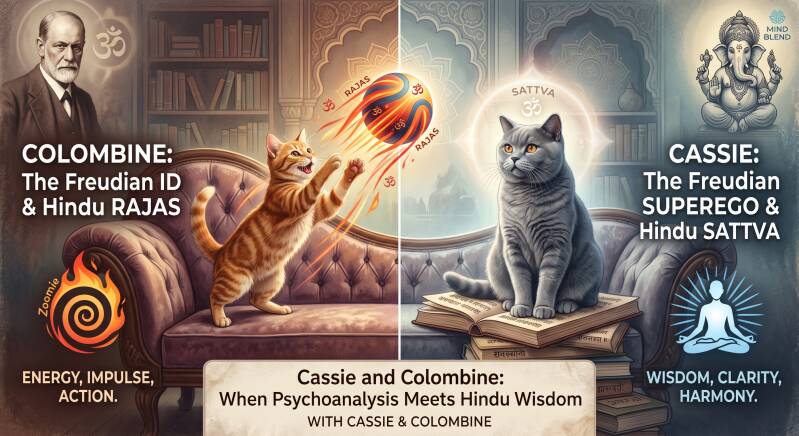
1. Colombine: Between the Freudian "Id" and "Rajas" Energy
-
Psychoanalysis Side: The Id (or Ça in French) is the seat of life drives, immediate desire, and the pleasure principle.
-
Hinduism Side: Rajas is the energy of movement, passion, desire, and activity.
-
Colombine's Illustration: When Colombine gets her famous "zoomies" (running wild after an invisible toy), she perfectly embodies this dynamic force. She is driven by Rajas: a raw, joyful energy that pushes for action. In her, the Id expresses itself as a sparkling and untamable spark of life.
2. Cassie: Between the "Superego" and the "Sattva" State
-
Psychoanalysis Side: The Superego (or Surmoi) represents the ideal, wisdom, self-discipline, and the observation of rules.
-
Hinduism Side: Sattva is the quality of light, clarity of mind, peace, and purity.
-
Cassie's Illustration: Sitting majestically on her cat tree, Cassie watches Colombine's agitation with a detachment worthy of a yogi in deep meditation. She embodies the peace of Sattva. She steps in to restore order if necessary, but prefers to maintain the home's harmony through her calm and structuring presence.
3. The "Ego" and "Ahamkara" (The Ego)
The Freudian Ego (or Moi) seeks balance between our inner drives and the external world. In Hindu psychology, the equivalent is Ahamkara (the sense of individuality or ego). This is what allows Cassie and Colombine to have self-awareness, adapt to their human environment, and cleverly negotiate a pet or a treat at the perfect moment.
II. Unconscious, Dreams, and "Samskaras" (The Imprints of the Mind)
For Freud, the unconscious mind houses hidden memories and desires. In Hindu thought, we speak of Samskaras: psychic imprints left on our minds by past experiences (and sometimes, according to tradition, by the thread of Karma).
Deep Sleep (Tamas) and Dreams
The third Guna, Tamas (darkness, deep sleep, necessary rest), is essential for integrating these imprints. When you see Cassie and Colombine twitching gently in their sleep (whiskers twitching, little paws running in the air), they are on a deep unconscious journey. They are releasing their feline Samskaras: memorable hunts, old games, or ancestral instincts of the great wild cats of Asia.
The Art of Saving Face (Rationalization)
If Colombine misses a jump on a chair and slips, she stops instantly and begins to lick her paw with a detached air.
-
In psychoanalysis, this is rationalization (a defense mechanism to protect the Ego).
-
In Hindu culture, this illustrates Maya (illusion): the cat creates an illusion of perfect confidence to mask the reality of a temporary slip!
III. Paths to Peace: From Sublimation to Meditation
To deal with daily frustrations, our two cats use methods that recall both psychoanalytic defense mechanisms and yogic practices.
-
Sublimation and Karma Yoga (Selfless Action): Cassie expresses her hunting instinct in a noble way. Unable to catch the birds outside, she channels this energy toward her toy mouse or a paper ball. She transforms her drive into concentrated, precise play—a form of pure action.
-
Displacement and the Flow of Energy: Sometimes, Colombine is frustrated when a door is closed. To release this tension, she might gently scratch her scratching post or roll a ball. She displaces her blocked energy toward a neutral object to restore the flow of her Prana (vital energy).
-
Regression and Returning to the Source: Cassie or Colombine "making biscuits" on a cozy blanket while purring is a moment of regression to kittenhood. It is also a state of Dhyana (deep meditation) where the cat reconnects with a sense of complete safety and unity with her environment.
IV. "Purr-Therapy" as a Sacred Mantra
In psychoanalytic therapy, speech liberates. In Hindu tradition, the vocal vibrations of Mantras (like the primordial sound OM) have the power to heal and soothe the mind.
The purring of Cassie and Colombine works exactly like a vibrational mantra. Their purrs emit low frequencies (between 20 and 50 Hz) that calm the human nervous system, reduce anxiety, and regulate heart rate. By their simple, loving presence on our laps, they act as spiritual guides, inviting us into the present moment (Mindfulness).
Conclusion: Two Little Guides of Wisdom on Paws
Sigmund Freud used to say that time spent with cats is never wasted. On their part, the sages of ancient India have always respected animals as carriers of sacred souls (Atman).
In their own way, Cassie and Colombine are both wonderful therapists of the unconscious and little spiritual masters. By balancing the movement of Rajas (Colombine's energy) and the peace of Sattva (Cassie's wisdom), they show us the path to a harmonious, peaceful life full of warm purrs.
Add comment
Comments