

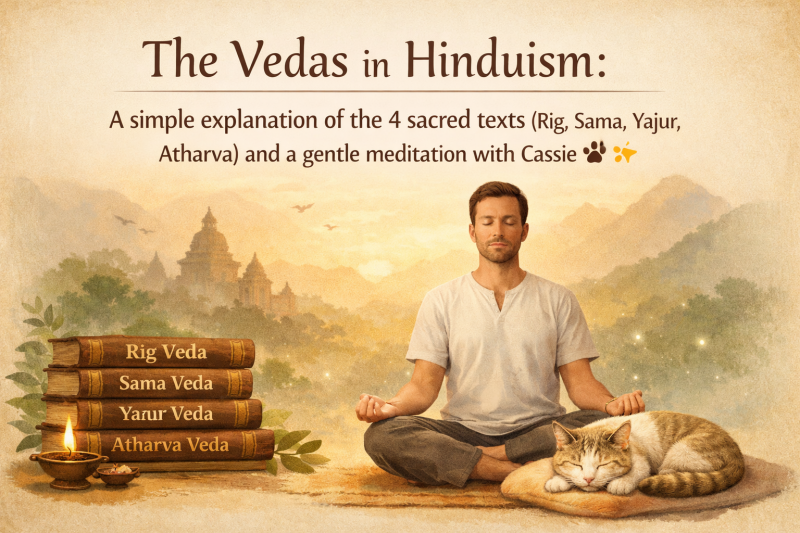
Hinduism: The Vedas 🌿📜 (and Cassie is watching over everything 🐾)
You may have already heard this word: the Vedas.
In Hinduism, it’s like opening a very ancient library… where every page breathes sacredness, wisdom, chants, and meditation ✨
And while I explain all this, Cassie is here, calm like a zen guardian, half asleep… but still attentive 😺🧘♂️
1) What are the Vedas exactly?
The Vedas are the oldest and most sacred texts of the Hindu tradition.
The word “Veda” means “knowledge” or “wisdom.”
👉 They are not only books: they are chants, prayers, sacred formulas, and a way to connect human beings to the cosmos.
People often say the Vedas were “heard” (not invented), because they come from a very ancient oral tradition.
2) Which Vedas are there? The 4 Vedas 🗺️
👉 When we talk about the Vedas, we are actually talking about four major sacred texts (four “Vedas”).
There are four main Vedas. Each one has its own role and energy.
✅ 1. Rig Veda
The oldest one.
It contains hymns dedicated to the forces of nature: fire, wind, sky, light…
📌 It feels like a song of gratitude to the universe.
✅ 2. Sama Veda
It turns many hymns from the Rig Veda into melodies.
📌 It is the Veda of sacred chanting, almost like sound meditation.
✅ 3. Yajur Veda
It gathers ritual formulas used in ceremonies.
📌 It guides gestures, offerings, and inner discipline.
✅ 4. Atharva Veda
Closer to everyday life.
It contains prayers for protection, health, peace, and also deep reflections.
📌 You can feel a spirituality connected to real life.
3) The structure of the Vedas (simple and clear) 🧩
Each Veda is not one single text, but a set of parts.
🔸 The Samhitas
The hymns and mantras.
🔸 The Brahmanas
The ritual explanations: why we do certain rituals, how to understand them.
🔸 The Aranyakas
The “forest” texts: more contemplative, more inward.
🔸 The Upanishads
The most famous for many people.
They speak about:
-
the soul (Atman)
-
the Absolute (Brahman)
-
consciousness
-
inner liberation
📌 Here we move from ritual to philosophy and meditation.
4) Why are the Vedas still important today? 🌙
Even though these texts are very old, they still speak to our modern world.
Because they ask universal questions:
-
Who am I really?
-
What is consciousness?
-
How can I live in harmony with the world?
-
How can I transform fear into peace?
And honestly… when I read some passages, I feel like they speak directly to our modern stress.
Cassie already understands:
she lies down, breathes, and silently says:
“Come back to the present moment.” 😺✨
5) The Vedas and mindfulness: a natural bridge 🧘♂️🌿
The Vedas are not only “texts.”
They invite us into a quality of presence.
In practice:
-
we repeat a mantra
-
we listen to silence
-
we breathe with intention
-
we observe life as a sacred movement
📌 It is a spirituality that can become inner hygiene.
6) A soft mini-ritual (1 minute) with Cassie 🐾
If you want a simple practice:
-
Sit comfortably
-
Place one hand on your heart
-
Breathe in slowly
-
Breathe out even more slowly
-
Repeat in your mind:
“I am calm. I am present. I am alive.”
Cassie also recommends a bonus step:
6. Pause. Do nothing. 😼
7) Sacred texts (inspired by the Vedas / Upanishads) for Cassie & me 🐾✨
Here are sacred sentences (inspired by the spirit of the Vedas and the Upanishads) that you can read like gentle mantras.
They match my path of presence… and Cassie’s silent wisdom 😺🧘♂️
1) Presence
“I return to the breath. I return to the moment. I return to myself.”
2) Inner peace
“May my heart be calm, like a lake without wind.”
3) Protection
“May the light protect me, may peace surround me, may fear dissolve.”
4) Consciousness (Upanishad style)
“I am not the noise of the world. I am the awareness that listens.”
5) Gentle strength
“I am stable, even when everything moves.”
6) Respect for life
“I respect life. Life answers me.”
7) Liberation
“I release what is heavy. I keep what lifts me up.”
8) Mini-mantra “Cassie & me” (simple and powerful) 🌿
Repeat softly 3 times:
“I breathe. I am at peace. We are safe.” 🐾
Conclusion 🌸
The Vedas are not only the history of Hinduism.
They are an invitation to inner knowledge, respect for life, and deep presence.
And if a cat can meditate while sleeping…
then we too can learn to breathe and return to what truly matters 🐾💛
Add comment
Comments